A liability waiver is a signed document in which a person agrees to accept the risks of an activity and gives up the right to sue the business or organizer for injuries or losses caused by ordinary negligence. Businesses ask customers to sign one before activities with some risk of injury, such as fitness classes, rentals, tours or body art. It is also called a waiver of liability, release of liability or exculpatory agreement.
A waiver does not make a business immune from every claim. It is one tool, along with safe practices and insurance, that lowers the chance of a successful lawsuit.
What "waiver of liability" means
To waive something is to give it up voluntarily. In a waiver of liability, the signer gives up a legal right: the right to hold the other party responsible (liable) for certain harm. The business is usually called the "released party" and the customer the "releasor" or participant.
A typical waiver has three working parts:
- Assumption of risk. The signer acknowledges the activity has risks, often listed, and accepts them.
- Release. The signer gives up claims against the business for injuries connected to the activity, often including the business's ordinary negligence.
- Hold harmless or indemnity. The signer agrees to cover claims others bring because of the signer's actions.
Most also include a health statement, emergency medical consent, rules to follow, and a section for a parent or guardian when children take part.
Waiver vs release: is there a difference?
In everyday use, "liability waiver" and "release of liability" mean the same document, and most courts treat them the same way. If you want to be precise:
| Term | Emphasis | Typical use |
|---|---|---|
| Liability waiver | The signer gives up (waives) a right before the activity | Gyms, studios, rentals, events |
| Release of liability | The signer frees (releases) the other party from claims | Same as above, and also settlements after an incident |
| Hold harmless agreement | The signer will not hold the other party responsible and may cover third-party claims | Venue rentals, contractors, vendors |
| Assumption of risk | The signer acknowledges and accepts specific risks | Usually a section inside a waiver |
The biggest practical difference is timing. A pre-injury release or waiver is signed before an activity. A post-injury release is signed after an incident, usually in exchange for a payment, to settle a claim. This guide is about the first kind. For a full comparison, read waiver vs release vs hold harmless.
What a liability waiver covers, and what it does not
Usually covered, where state law allows:
- Injuries from the inherent risks of the activity, like a sprained ankle in a dance class
- Injuries caused by the business's ordinary negligence, if the waiver says so clearly
- Damage to the signer's own property during the activity
Usually not covered:
- Gross negligence, recklessness or intentional harm
- Violations of safety laws in some states
- Claims in states that refuse pre-injury personal injury waivers, such as Virginia and Louisiana
- In many states, a child's own claims, even when a parent signed
More detail is in are liability waivers enforceable.
When does a business need a liability waiver?
If your customers do something physical, use your equipment, or put something on or into their body, a waiver is worth having. Common examples:
- Fitness: gyms, personal training, yoga, martial arts, CrossFit. See the gym waiver and yoga waiver.
- Recreation and rentals: bikes, boats, kayaks, horseback riding, escape rooms, trampoline parks.
- Kids and events: camps, parties, bounce houses, sports teams. See the summer camp waiver.
- Beauty and body art: tattoos, piercing, microblading, waxing. These often combine a consent form with a release. See the tattoo consent form.
- Volunteers and community programs: cleanups, builds, charity runs. See the volunteer waiver.
Some insurers also require signed waivers as a condition of coverage, so check your policy.
Example of a liability waiver clause
"I understand that participating in [activity] involves risks of injury, including [main risks]. I voluntarily assume these risks. To the fullest extent permitted by law, I release [Business Name], its owners and staff from all claims for injury or property damage arising from my participation, including claims caused by their ordinary negligence."
That paragraph is the heart of most waivers. A complete document adds the activity description, health statement, rules, minors section, severability and signature. Our step-by-step guide on how to write a liability waiver covers each part.
Waivers and consent forms
Some businesses need a consent form rather than, or as well as, a waiver. The difference is focus. A waiver is about giving up claims. A consent form is about agreeing to a specific service or treatment after being told what it involves, such as a tattoo, a facial or a massage. Body art and beauty businesses often combine both in one document: the client consents to the procedure, confirms health information, accepts the known risks and releases the business from claims for ordinary negligence. Event and camp organizers often pair a waiver with a photo release and medical consent.
If you are not sure which you need, think about what could go wrong. If the risk is physical injury during an activity, you need a waiver. If the risk is a reaction to a treatment the client agreed to, you need informed consent, and usually a release too.
Who should sign
- Every adult participant, before the activity, in their own name.
- A parent or legal guardian for each minor, with the child's name and date of birth. See can a parent sign a waiver for a child.
- Not a friend or group leader on behalf of other adults. Each adult should sign for themselves, which is easier with group links where everyone signs on their own phone.
How long a waiver lasts
A waiver lasts as long as its text says. Some cover a single visit or event, others cover all visits for a period such as 12 months. Ongoing memberships often use an annual waiver and ask members to sign again when it expires or when the document changes. Keep signed copies for at least as long as someone could bring a claim in your state, which can be longer for minors.
Is an online waiver valid?
Generally, yes. Under the federal ESIGN Act and state UETA laws, an electronic signature has the same legal effect as one on paper. What you need is a reliable record of who signed, when, and exactly what they agreed to. See are electronic signatures legally binding.
This guide is general information, not legal advice. Waiver rules vary by state, so have a local attorney review your waiver.
Getting started
If you need a waiver now, start from the free liability waiver template and edit it for your activity. FairWaiver lets customers sign it online on any phone or tablet before they arrive or at a kiosk at the front desk, and keeps every signed copy searchable. The free plan covers one form and 25 signatures a month.
Frequently asked questions
What is the purpose of a liability waiver?
Its purpose is to inform participants about the risks of an activity and to release the business from claims for injuries caused by those risks and by ordinary negligence. It also creates a record that the person understood and accepted the risks.
Is a waiver of liability the same as a release of liability?
In practice, yes. Both names are used for the same pre-activity document, and most courts treat them the same. "Release" is also used for settlement documents signed after an injury.
Does a liability waiver protect against negligence?
In most states it can protect against ordinary negligence if it says so clearly. It generally does not protect against gross negligence, recklessness or intentional harm.
Do I need a liability waiver for my small business?
If customers take part in physical activities, use your equipment or receive body treatments, a waiver is a sensible part of your risk management, along with insurance and safe practices. Some insurers require one.
Can someone refuse to sign a waiver?
Yes. Signing is voluntary. A business can generally decline to let someone take part in an optional activity if they do not sign.
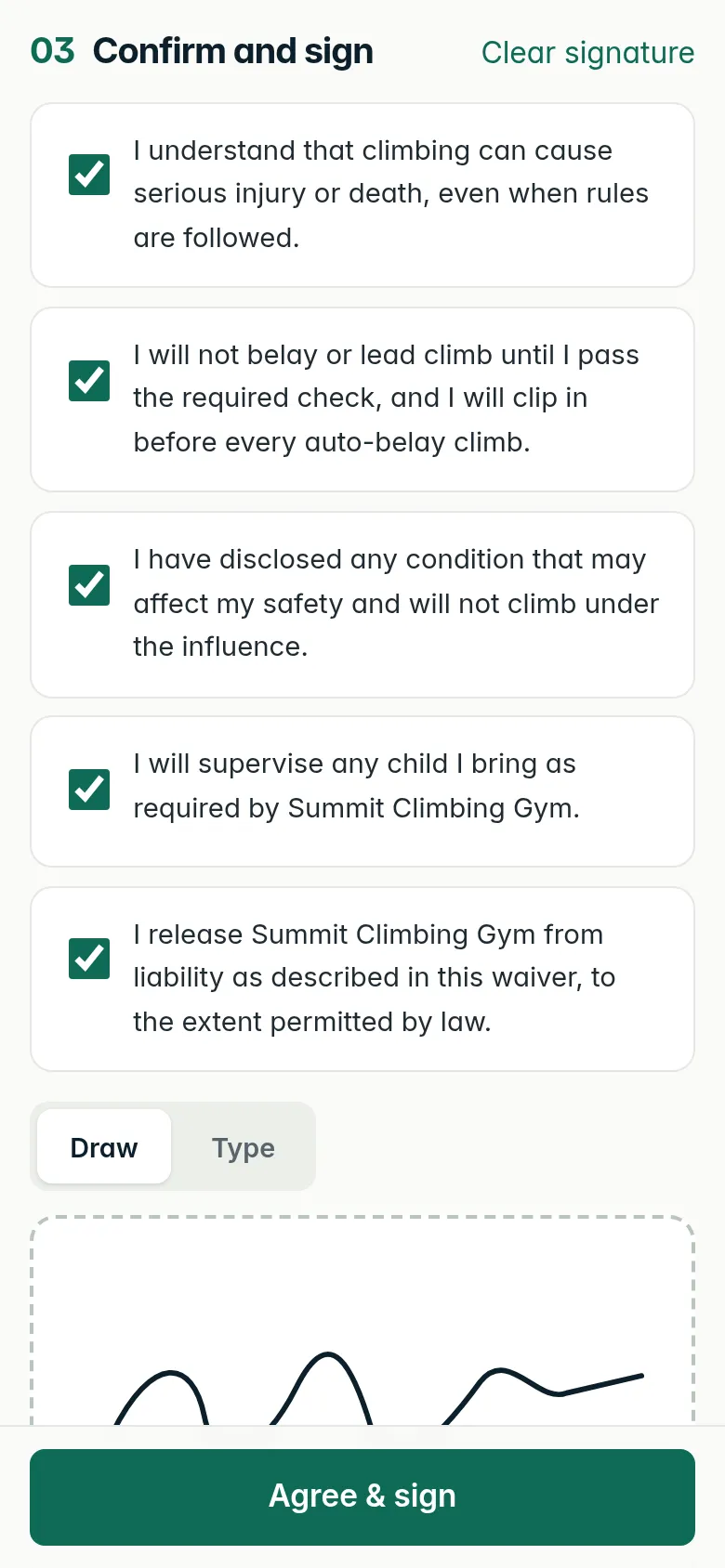
Collect signed waivers online
Customers sign on their phone, a QR code or a front-desk tablet. Every signature is stored as a PDF with an audit trail. Free for 25 signatures a month.
Start free