To write a liability waiver, name the parties, describe the activity and its risks, have the signer assume those risks, include a clear release of claims (mentioning negligence), add a hold harmless clause and the standard legal clauses, then collect a dated signature before the activity. Keep the language plain and the release easy to see. Then have a local attorney review it, because waiver rules vary by state.
The steps below walk through each part with sample wording. If you would rather start from a finished document, use the free liability waiver template or the release of liability form and edit them as you read.
Before you start
Answer three questions first:
- What exactly is the activity? A trampoline session, a boat rental and a tattoo are very different, and the waiver should say which one it covers.
- Who will sign? Adults only, or also parents for children? Group bookings?
- Which state's law applies? Most states enforce clear waivers for ordinary negligence, but a few restrict them heavily. See are liability waivers enforceable.
Step 1: Give it a clear title
Use a title that says what it is: "Release of Liability, Assumption of Risk and Hold Harmless Agreement." A vague title like "Registration Form" makes it easier to argue the signer did not know they were giving up rights.
Step 2: Identify the parties
Name your business (the legal entity), and leave space for the participant's full name, date of birth and contact details. If others are protected too, say so: "[Business Name], its owners, employees, instructors and volunteers."
Step 3: Describe the activity
Be specific about what, where and when. Example:
"Use of the climbing walls, bouldering area and equipment at [Business Name], including instruction, classes and open climbing sessions."
Step 4: List the risks and the assumption of risk
Describe the main risks in plain words, then have the signer accept them. Courts look for evidence the signer knew what they were accepting.
"I understand that climbing involves risks including falls, equipment failure, collisions with other climbers, sprains, broken bones, and in rare cases serious injury or death. I voluntarily assume all of these risks, known and unknown."
Step 5: Write the release of liability
This is the core of the waiver. Make it clear and, where your state requires it, name negligence expressly.
"To the fullest extent permitted by law, I release [Business Name] and its staff from any and all claims for injury, illness, death or property damage arising from my participation, including claims caused by the ordinary negligence of [Business Name]."
Step 6: Add a hold harmless and indemnity clause
This covers claims brought by others because of the signer's actions. For a deeper look, read hold harmless clause explained.
"I agree to indemnify and hold harmless [Business Name] from any claims, costs or attorney fees arising from my actions or the actions of any guest I bring."
Step 7: Add health and fitness statements
Have the signer confirm they are fit to take part and will tell staff about relevant conditions. For some activities, add a medical treatment consent so staff can call for help in an emergency.
Step 8: Add rules and conduct
Short, activity-specific rules help: follow staff instructions, use the equipment provided, no alcohol before participating. These also support a defense that the signer was told how to stay safe.
Step 9: Handle minors
If children take part, add a parent or guardian section: the child's name and date of birth, the guardian's relationship to the child, and a statement that the guardian has authority to sign. Whether a parent can waive a child's claims depends on the state. See can a parent sign a waiver for a child.
Step 10: Add the standard legal clauses
- Severability: if one part is invalid, the rest stays in force.
- Governing law: the state whose law applies.
- Entire agreement: this document is the full agreement on the subject.
- Duration: whether the waiver covers one visit or all visits for a period (for example 12 months).
Step 11: Add an acknowledgement and signature
End with a plain statement right above the signature:
"I have read this document, I understand that I am giving up legal rights, and I sign it voluntarily."
Then signature, printed name and date. Asking the signer to tick or initial the key sections (risks, release, medical) adds evidence they read them.
Essential clauses at a glance
| Clause | What it does | Required? |
|---|---|---|
| Activity description | Defines what the waiver covers | Yes |
| Assumption of risk | Signer accepts known risks | Yes |
| Release of liability | Signer gives up claims, including ordinary negligence | Yes |
| Hold harmless and indemnity | Signer covers third-party claims they cause | Recommended |
| Medical consent | Allows emergency treatment | For physical activities |
| Minor and guardian section | Parent signs for a child | If children take part |
| Photo or media release | Permission to use photos | Optional, keep separate tick box |
| Severability and governing law | Keeps the rest valid, sets the state | Yes |
| Signature, date, acknowledgement | Proves agreement | Yes |
Mistakes that get waivers thrown out
- Vague language such as "not responsible for accidents," without mentioning negligence or claims.
- Fine print. Tiny text, or the release hidden among unrelated terms.
- Overreaching. Trying to waive gross negligence or intentional harm can make a court distrust the whole document. Use "to the fullest extent permitted by law."
- A generic template that does not match the activity.
- Signing too late, after the activity started or after an injury.
- Only the child signs, or no relationship recorded for the adult.
- No record of the exact version signed. If you edit the waiver, you need to show what each person agreed to on the day.
- Never reviewing it. Activities, staff and laws change.
Checklist before you use your waiver
- Clear title that includes "Release of Liability"
- Business legal name and all protected parties listed
- Specific activity, location and time period
- Main risks listed in plain words
- Assumption of risk statement
- Release that mentions negligence (where your state allows)
- Hold harmless and indemnity clause
- Health statement and emergency medical consent
- Parent or guardian section, if minors take part
- Severability and governing law
- Acknowledgement right above the signature
- Reviewed by a local attorney
- A system to store each signed copy with date and time
This guide is general information, not legal advice. Have a local attorney review your final waiver.
Collecting the signatures
Once your text is ready, the hard part is collecting it from every person, every time. FairWaiver turns your waiver into an online form people sign on their own phone or on a tablet at the front desk, with tick boxes, initials, a parent section for minors and expiry dates. You can also upload the waiver you already have, and every signed copy is saved with an audit trail. The free plan includes 25 signatures a month.
Frequently asked questions
Can I write my own liability waiver?
Yes. There is no rule that a lawyer must write it. A clear, specific waiver based on a good template is a solid start, but have a local attorney review it, because enforceability depends on state law.
What should a liability waiver include?
At minimum: the parties, a description of the activity, the risks, an assumption of risk, a release that mentions negligence, a hold harmless clause, severability, governing law, and a dated signature. Add medical consent and a parent section where relevant.
How long should a liability waiver be?
Long enough to be specific, short enough to be read. Most small business waivers are one to three pages. Clear headings matter more than length.
Does a liability waiver need to be notarized?
Generally no. Most waivers only need the signer's signature and date. Some specific agreements, or a business's own policy, may call for notarization, so check with an attorney if you are unsure.
How long is a signed waiver valid?
As long as the waiver says. Many businesses make it valid for one visit or for 12 months, then ask people to sign again. Keep records for at least as long as the statute of limitations in your state, which for minors can run years past their 18th birthday.
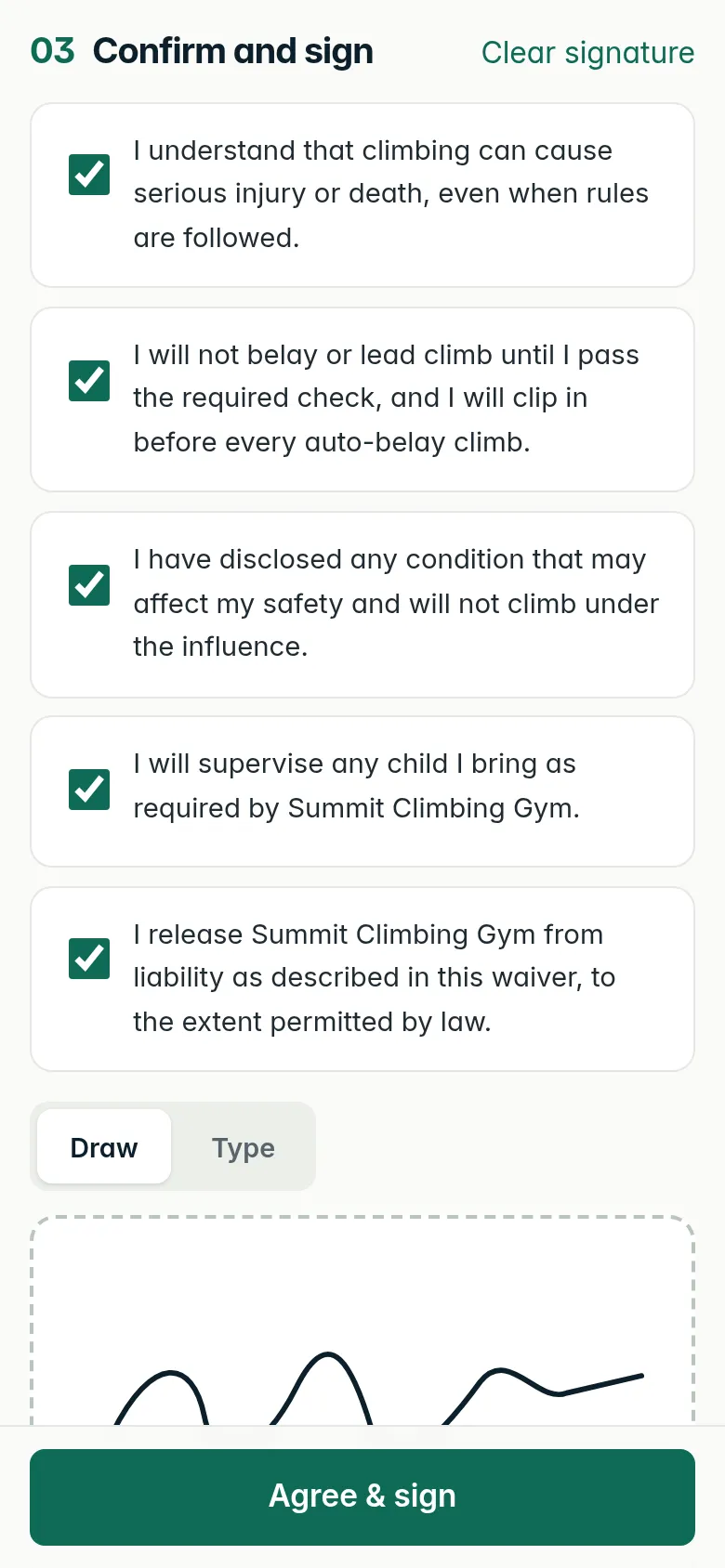
Collect signed waivers online
Customers sign on their phone, a QR code or a front-desk tablet. Every signature is stored as a PDF with an audit trail. Free for 25 signatures a month.
Start free