A hold harmless clause is a provision in a contract where one party agrees not to hold the other party liable for certain losses, injuries or damages, and often agrees to cover claims brought by third parties. It appears in leases, rental agreements, service contracts, event bookings and liability waivers. Whether it holds up depends on how clearly it is written and on your state's law.
Unlike a standalone hold harmless agreement, a clause is just one paragraph inside a larger contract. That paragraph often decides who pays when something goes wrong, so it is worth understanding.
What a hold harmless clause does
A typical clause contains up to three promises:
- Release (hold harmless): the signer will not bring claims against the protected party for their own losses.
- Indemnity: the signer will reimburse the protected party for losses, including settlements or judgments, from third-party claims.
- Defense: the signer will pay for or provide the legal defense when a claim is filed.
A clause can include one, two or all three. "Hold harmless" alone is sometimes read narrowly, so contracts usually say "release, indemnify, defend and hold harmless" to make the intent clear.
Hold harmless clause examples
The examples below show the structure. They are illustrations, not ready-to-use legal text, and should be adapted and reviewed by an attorney for your state.
Limited form (signer covers only their own fault)
"Renter agrees to indemnify, defend and hold harmless [Business Name], its owners and employees from any claims, losses or expenses, including reasonable attorney fees, to the extent caused by the negligent acts or omissions of Renter, its guests or contractors during the rental period."
Intermediate form (signer covers shared fault)
"Contractor shall indemnify and hold harmless Owner from all claims for bodily injury or property damage arising out of Contractor's work, whether or not caused in part by Owner, except claims caused by the sole negligence or willful misconduct of Owner."
Broad form (signer covers even the other party's sole fault)
"Contractor shall indemnify and hold harmless Owner from any and all claims arising out of the work, regardless of whether such claims are caused by Owner's sole negligence."
Broad form clauses are restricted or void in many states, particularly in construction contracts.
Mutual (reciprocal) clause
"Each party shall indemnify and hold harmless the other party from claims, losses and expenses to the extent arising from its own negligence or willful misconduct, or that of its employees and agents."
Participant release clause
"I release and hold harmless [Business Name] and its staff from any claims for injury or property damage arising from my participation in [activity], including claims based on the ordinary negligence of [Business Name], to the fullest extent permitted by law."
This last style is what you find in most liability waivers. See the release of liability form for a complete document built around it.
Where hold harmless clauses appear
| Contract | Who usually signs | Who is protected |
|---|---|---|
| Commercial or residential lease | Tenant | Landlord |
| Venue or room rental | Renter or event organizer | Venue owner |
| Equipment rental | Renter | Rental business |
| Construction or service contract | Contractor or subcontractor | Property owner or general contractor |
| Vendor or sponsor agreement | Vendor | Event organizer |
| Liability waiver for an activity | Participant (or parent) | Business running the activity |
| Independent instructor agreement | Instructor | Gym or studio |
Is a hold harmless clause enforceable?
Generally yes, when it is drafted well. Courts look at a few common factors:
- Clear and specific language. The clause should say what activity it covers and what kinds of claims. Some states require the clause to mention negligence expressly if it is meant to cover the protected party's own negligence.
- Conspicuous placement. A clause buried in small print on page nine is easier to attack than one with its own heading and normal-size text.
- Fair bargaining. Courts are more skeptical when one side had no real choice, especially for essential services.
- Scope of fault. In most states a clause will not cover gross negligence, recklessness or intentional harm.
- State statutes. Many states have anti-indemnity laws, mostly for construction contracts, that void broad form clauses and sometimes intermediate ones. Some states also limit clauses in residential leases.
Courts tend to read these clauses strictly against the party that wrote them. If something is ambiguous, expect it to be interpreted in the signer's favor. For more on how courts treat releases in general, read are liability waivers enforceable.
Real-world scenarios
A dance studio renting to an outside teacher. The studio adds a limited form clause to the room rental agreement: the teacher covers claims from her own students, to the extent her class caused them. If a ceiling light falls because the studio ignored a repair, that stays the studio's problem, which is fair and more likely to be enforced.
A food truck at a weekend market. The organizer's vendor agreement says the vendor will indemnify, defend and hold harmless the organizer for claims arising from the vendor's food, equipment and staff, and asks for a certificate of insurance. If a customer gets food poisoning and sues both, the vendor's insurer handles the defense.
A bike rental shop. The customer release includes a hold harmless sentence covering injuries to other people caused by the renter's riding. If the renter hits a pedestrian, the shop has a contractual basis to ask the renter to cover the claim.
In each case the clause matches the actual relationship. That fit is one of the best predictors of whether a clause holds up.
Tips for writing a stronger hold harmless clause
- Name the protected parties: the business, its owners, employees, and agents.
- Define the activity, location and time period.
- Use all three verbs if you mean them: indemnify, defend and hold harmless.
- Say whether attorney fees are included.
- Match the scope to what your state allows. Limited form is the safest starting point.
- Pair it with an insurance requirement for contractors and vendors.
- Add a severability clause, so if one part fails the rest survives.
- Keep a signed, dated copy of every version people actually signed.
Common mistakes
- Copying a broad form clause from a construction contract into a small rental agreement in a state that bans it.
- Writing "hold harmless" without saying from what.
- Hiding the clause inside unrelated terms.
- Relying on the clause instead of insurance. An indemnity promise from a person with no assets or coverage rarely pays anything.
- Editing the contract later without keeping the version each person signed.
This guide is general information, not legal advice. Laws differ by state, so have a local attorney review any clause before you rely on it.
Putting the clause to work
If you need a complete document rather than a single clause, the free hold harmless agreement template includes release, indemnity, insurance and severability sections you can edit. FairWaiver lets you send it as a link, collect signatures on any phone or tablet, and keep a copy of the exact text each person signed.
Frequently asked questions
What does a hold harmless clause mean?
It means one party agrees not to hold the other responsible for certain losses or injuries and, usually, to cover claims from third parties. The exact scope depends on the wording of the clause.
Is a hold harmless clause the same as an indemnification clause?
They overlap and are often combined. Hold harmless focuses on not making claims against the other party, while indemnification focuses on paying back losses, especially from third-party claims. Some courts treat them as the same, so contracts usually include both.
Can a hold harmless clause protect against negligence?
In many states it can cover ordinary negligence if the clause says so clearly. Most states will not enforce it against gross negligence, recklessness or intentional misconduct.
Where should a hold harmless clause go in a contract?
Give it its own heading and place it where the signer will read it, not in fine print. Many businesses also ask signers to initial or tick a statement next to it.
Are hold harmless clauses enforceable in construction contracts?
Often only partly. Many states have anti-indemnity statutes that void broad form clauses in construction contracts, and some limit intermediate form too. Check your state's rules with an attorney.
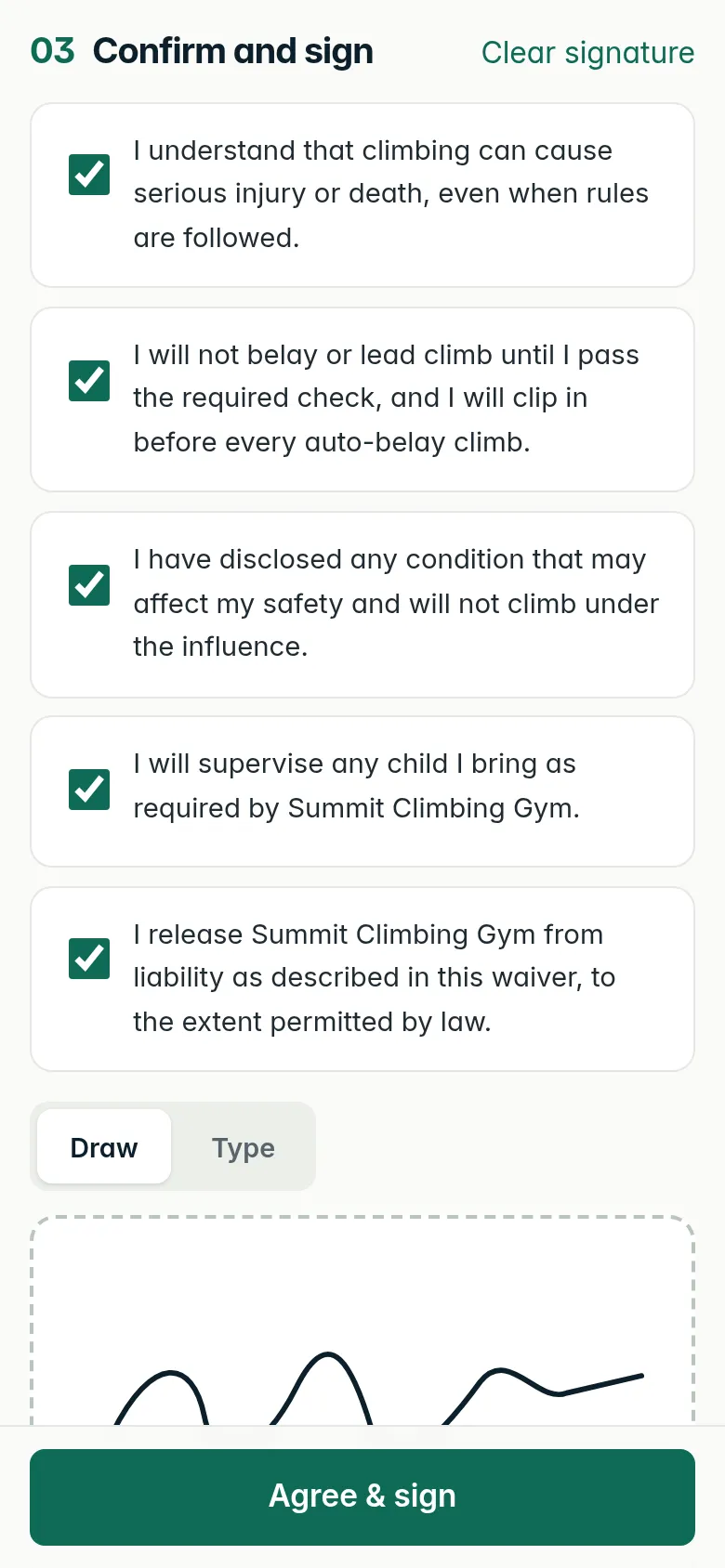
Collect signed waivers online
Customers sign on their phone, a QR code or a front-desk tablet. Every signature is stored as a PDF with an audit trail. Free for 25 signatures a month.
Start free