In most US states, a liability waiver is enforceable for ordinary negligence when it is clearly written, easy to see, signed voluntarily and does not violate public policy. Waivers usually do not protect a business from gross negligence, recklessness or intentional harm, and a few states refuse to enforce pre-injury waivers for personal injury at all. So the honest answer to "do waivers hold up in court?" is: often, but not always, and it depends heavily on the wording and the state.
Important: this guide is general information, not legal advice. Waiver law is made mostly by state courts and legislatures, it changes, and outcomes depend on the facts. Have a local attorney review your waiver.
Why waivers are generally binding
A liability waiver is a contract. Adults are generally free to agree to accept the risks of an activity and give up the right to sue for injuries caused by the other party's ordinary carelessness. Courts in most states respect that choice, especially for voluntary recreational activities like climbing, horseback riding, trampolines or fitness classes.
At the same time, courts do not like contracts that excuse someone from their own negligence, so they read waivers strictly. If there is any doubt about what the signer agreed to, the doubt usually goes against the business that wrote it.
What courts look at
Details vary by state, but these factors come up again and again.
1. Clear and unambiguous language
The waiver must say plainly what rights the signer is giving up. Many states require that a waiver of the business's own negligence actually use the word "negligence" or something equally clear. Vague phrases like "not responsible for any accidents" are a common reason waivers fail.
2. Conspicuous presentation
A release hidden in small print at the bottom of a membership form is easy to attack. Courts favor waivers with a clear title ("Release of Liability"), headings, readable font size and a signature placed right after the release language.
3. Specific to the activity and its risks
A waiver that describes the actual activity and its typical risks shows the signer knew what they were accepting. A one-size-fits-all paragraph is weaker.
4. Voluntary signing and fair bargaining
Courts ask whether the signer had a real choice. Recreational activities are optional, which helps. Waivers for essential services, or signed under time pressure, are more likely to be thrown out.
5. Public policy
Many courts use some version of the test from the California case Tunkl v. Regents of the University of California (1963), which looks at whether the business serves an important public need, such as hospitals or schools. Waivers for those services are often void. Waivers for optional recreation usually pass this test.
6. Level of fault
Nearly every state refuses to enforce a waiver against gross negligence, recklessness or intentional misconduct. Some also refuse waivers that would excuse violations of safety statutes.
7. Who signed
The signer must be an adult with capacity to contract. Waivers signed by minors are generally voidable, and waivers signed by parents for children are treated very differently from state to state. See can a parent sign a waiver for a child.
When waivers usually hold up vs fail
| Usually holds up | Often fails |
|---|---|
| Ordinary negligence, like a minor maintenance lapse | Gross negligence or reckless conduct |
| Optional recreational or fitness activity | Essential services such as medical care or housing |
| Clear title, headings, the word "negligence" | Vague wording or tiny fine print |
| Risks of the specific activity described | Generic text that does not match the activity |
| Adult signer, signed before the activity | Minor signer, or signed after an injury |
| A copy of the exact signed text is on file | No record of what was signed or when |
How state law changes the answer
Waiver law varies a lot by state. In broad terms:
- Most states enforce clear waivers for ordinary negligence in recreational settings.
- A few states are known to be strict. Virginia's Supreme Court held in Hiett v. Lake Barcroft Community Association (1992) that pre-injury releases of liability for personal injury caused by negligence are void as against public policy. Louisiana's Civil Code (Article 2004) makes null any clause that excludes or limits liability in advance for causing physical injury to the other party. Montana has a statute that has long been read to limit such waivers, though it has since passed recreation-specific legislation, so the picture there is more nuanced.
- Some states have statutes for specific activities, such as equine activities, skiing or recreation, that limit liability for inherent risks or set rules for warnings and release language.
- Minors are handled very differently from state to state.
Because these rules change through new court decisions and statutes, check your state's current law with a local attorney before relying on any waiver.
Do electronic waivers hold up?
Generally yes. Under the federal ESIGN Act and state UETA laws, a signature cannot be denied legal effect just because it is electronic. What matters in court is proof: who signed, when, and exactly what text they agreed to. An electronic system with a good audit trail often makes that easier to prove than a paper form in a box. Read more in are electronic signatures legally binding.
How to make your waiver more likely to hold up
- Title it clearly, for example "Release of Liability and Assumption of Risk."
- Describe your specific activity and its main risks.
- State plainly that the signer releases claims, including those caused by your ordinary negligence, to the extent your state allows.
- Use headings, normal-size text and short paragraphs.
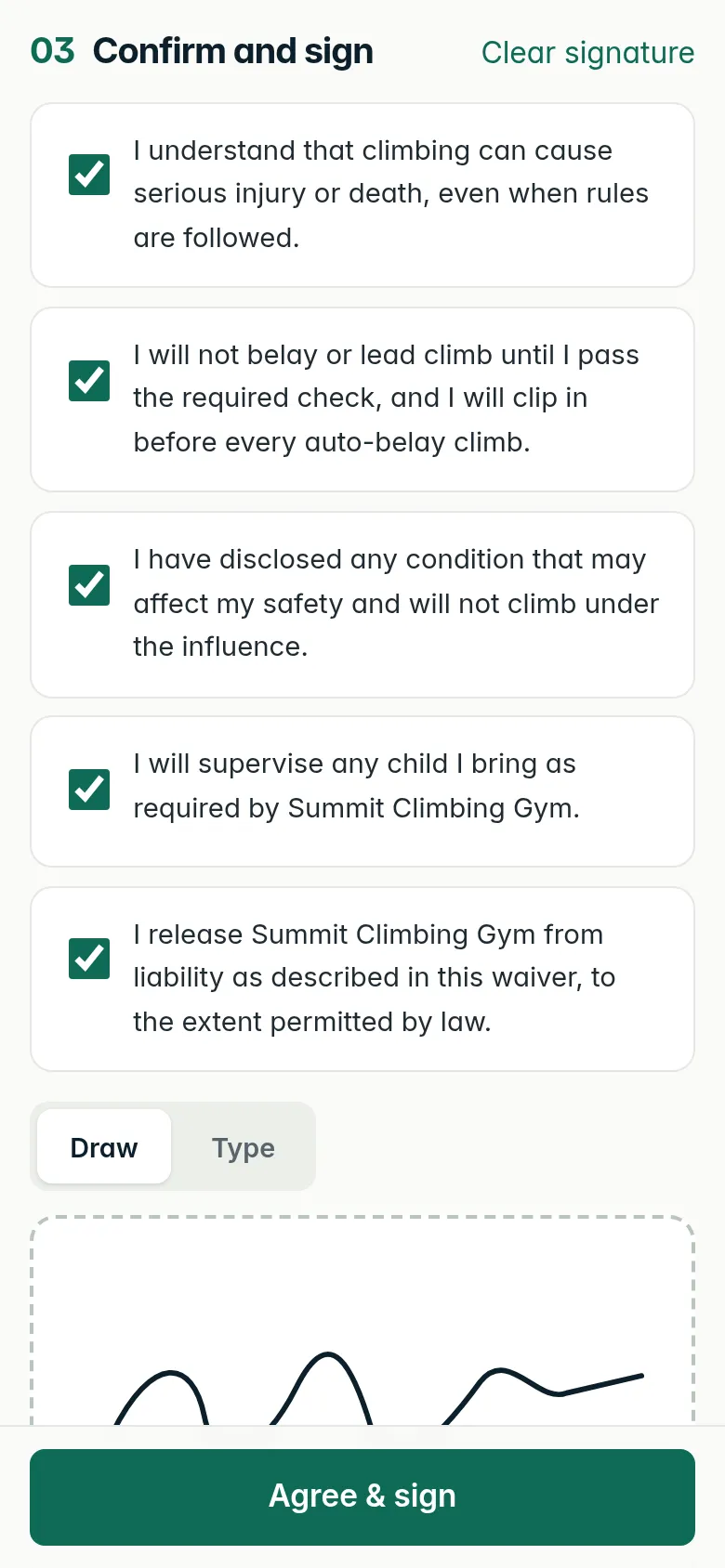
- Ask signers to tick or initial key sections, like assumption of risk and the release.
- Have people sign before the activity, not at the end.
- Collect a parent or guardian signature for minors and record the child's details.
- Keep the exact signed version, with the date and time, for every signer.
- Have a local attorney review the text, and update it when your activities change.
For a step-by-step walkthrough, see how to write a liability waiver.
Examples of how courts reason
These simplified scenarios show the kind of reasoning courts use. They are illustrations, not predictions for any real case.
- A gym member strains a shoulder on a well-maintained machine. This is an inherent risk of exercise, and a clear waiver covering ordinary negligence would likely be a strong defense in most states.
- A climbing gym ignores repeated reports of a frayed rope, and it snaps. A court may find gross negligence, which most states will not let a waiver excuse.
- A rental shop's release is printed in tiny gray text on the back of a receipt. A court may find it was not conspicuous and that the customer did not knowingly give up rights.
- A parent signs for a 10-year-old at a trampoline park. The outcome depends on whether the state lets parents waive a child's claims.
A waiver is one layer, not the whole plan
Even a strong waiver does not replace safe operations, staff training, equipment checks and insurance. Many claims are decided on whether the business acted reasonably, and some will be outside the waiver's reach no matter how it is written.
Collecting waivers you can find later
A waiver only helps if you can produce it. FairWaiver stores every signed waiver with the exact text, time, IP address, device and a document fingerprint, so you can pull up a record in seconds. You can start from the liability waiver template or the release of liability form on the free plan.
Frequently asked questions
Are waivers legally binding?
In most states a well-written waiver signed voluntarily by an adult is a binding contract for ordinary negligence. It usually does not cover gross negligence or intentional harm, and a few states restrict pre-injury waivers for personal injury.
Do waivers hold up in court?
Often, but not always. Courts check whether the language was clear and conspicuous, whether the signer understood the risks and signed voluntarily, and whether enforcing it would go against public policy or state law.
Can you sue if you signed a waiver?
You can still file a lawsuit, and the waiver becomes a defense the business raises. Claims for gross negligence, recklessness or intentional misconduct, or claims in states that restrict waivers, may still go forward.
Which states do not enforce liability waivers?
Virginia and Louisiana are the best-known states that generally refuse to enforce pre-injury releases for personal injury, and Montana has long been restrictive. Rules change, so confirm your state's current law with an attorney.
Is a waiver signed by a minor enforceable?
Generally no, because minors can usually void contracts. A parent or guardian signature is needed, and whether that binds the child's own claims depends on the state.
Are online waivers as enforceable as paper ones?
Yes, in general. The ESIGN Act and UETA give electronic signatures the same legal effect as handwritten ones, as long as you can show who signed and what they agreed to.
Collect signed waivers online
Customers sign on their phone, a QR code or a front-desk tablet. Every signature is stored as a PDF with an audit trail. Free for 25 signatures a month.
Start free