A waiver and a release of liability are mostly the same thing: the signer gives up their own right to sue you. A hold harmless agreement goes further by also shifting responsibility for claims that third parties bring, and an indemnity agreement is a promise to pay back losses from those claims. In practice, most small business documents combine all of them in one form, so the label matters less than the clauses inside.
Here is how each one works, a side-by-side comparison, and how to pick the right document.
Waiver (liability waiver)
To waive is to give up a right voluntarily. A liability waiver is signed by a participant before an activity and says they accept the risks and give up claims against the business for injuries, usually including ordinary negligence.
Who signs: the customer or participant (or a parent for a child). Protects against: claims by the signer. Example: a member signs a gym waiver before their first workout.
Release of liability
A release frees the other party from liability. A pre-activity release of liability is, for practical purposes, the same document as a liability waiver, and courts usually treat the two terms as interchangeable. The word "release" is also used for a different document: a settlement release signed after an incident, where someone gives up a claim in exchange for a payment.
Who signs: the participant (before) or the injured party (after, in a settlement). Protects against: claims by the signer. Example: a kayak renter signs a release of liability form before launching.
Hold harmless agreement
A hold harmless agreement is a promise not to hold the other party responsible for losses connected to an activity, property or job. It is usually signed by someone bringing their own activity, people or business onto your premises, and often includes a promise to cover claims from third parties.
Who signs: renters, contractors, vendors, event organizers, independent instructors (or participants, when the clause sits inside a waiver). Protects against: claims by the signer and, with indemnity language, claims by third parties. Example: a family renting a party hall agrees to handle claims from their guests.
Indemnity agreement
To indemnify is to compensate someone for a loss. An indemnity agreement (or clause) is a promise to pay back the other party's losses, settlements or legal costs arising from a claim, usually a claim by a third party. A "duty to defend" is often added, meaning the signer also pays for the legal defense from the start.
Who signs: usually contractors, vendors, tenants and business partners. Protects against: the financial cost of third-party claims. Example: a contractor agrees to indemnify a store owner if a customer trips over the contractor's tools.
Side-by-side comparison
| Liability waiver | Release of liability | Hold harmless agreement | Indemnity agreement | |
|---|---|---|---|---|
| Main idea | Give up the right to sue | Free the other party from liability | Do not hold the other party responsible | Pay back the other party's losses |
| Typical signer | Participant | Participant, or injured party in a settlement | Renter, contractor, vendor | Contractor, vendor, tenant |
| Covers claims by the signer | Yes | Yes | Yes | Sometimes |
| Covers claims by third parties | Only with an indemnity clause | Only with an indemnity clause | Often | Yes |
| Covers legal defense costs | Rarely | Rarely | If "defend" is included | If "defend" is included |
| When signed | Before the activity | Before, or after an incident | Before the activity or work | Before the work or contract |
| Common setting | Gyms, studios, rentals, tours | Rentals, events, settlements | Venue rentals, contractors | Construction, commercial contracts |
A worked example: one incident, four documents
Imagine a family rents a bounce house from a party rental company for a backyard birthday. A neighbor's child is hurt when the bounce house tips over in strong wind.
- The liability waiver the parent signed for their own children would be raised if one of those children sued, subject to the state's rules on parental waivers.
- A release of liability on the rental contract would be raised if the renting parent sued for their own losses.
- The hold harmless clause in the rental agreement is what matters for the neighbor's child, a third party who never signed anything. It says the renter is responsible for claims from guests.
- An indemnity clause, with a duty to defend, would require the renter to pay the rental company's legal costs and any settlement, to the extent the agreement and state law allow.
Whether any of these actually holds up depends on the facts, such as whether the company told the renter to anchor the unit and not to use it in high wind, and on state law. But the example shows why rental documents usually include every piece.
Where assumption of risk fits
"Assumption of risk" is not a separate type of agreement so much as a section in a waiver. The signer acknowledges the specific risks of the activity and accepts them. It supports the release and can help as a defense even where a release is limited, which is why most waivers include both. Many documents are titled "Release of Liability, Assumption of Risk and Hold Harmless Agreement" for this reason.
Why most forms combine them
Each piece closes a different gap:
- The assumption of risk shows the signer knew what they were getting into.
- The release stops the signer from suing for their own injuries.
- The hold harmless and indemnity language covers claims brought by others because of the signer's actions, like a renter's guest who gets hurt.
A well-built waiver for an equipment rental, for example, includes all three. A contractor agreement might lean on indemnity and insurance instead.
Which one do you need?
| Situation | Best fit | Template |
|---|---|---|
| Customers take part in a physical activity | Liability waiver or release | Liability waiver |
| Customers rent your equipment | Release with hold harmless | Release of liability form |
| Someone rents your venue for their own event | Hold harmless agreement | Hold harmless agreement |
| A contractor or vendor works on your property | Hold harmless and indemnity, plus insurance | Hold harmless agreement |
| Volunteers help at your program | Volunteer waiver | Volunteer waiver |
| Children take part | Waiver with a parent section | Parental consent form |
| You settle a claim after an incident | Settlement release | Have an attorney draft it |
Limits that apply to all of them
Whatever you call the document, the same general limits apply. Most states will not enforce any of these against gross negligence, recklessness or intentional harm. Language must be clear and conspicuous. A few states, such as Virginia and Louisiana, refuse pre-injury releases for personal injury, many states restrict broad indemnity clauses in construction contracts, and minors are treated differently from state to state. See are liability waivers enforceable and hold harmless clause explained for more.
This guide is general information, not legal advice. Have a local attorney review the document you choose.
Collecting the right document
Once you know which document fits, the next step is getting it signed every time. FairWaiver has free templates for each of these, lets you edit them or upload your own, and collects signatures online with a full audit trail. The free plan covers one active form and 25 signatures a month.
Frequently asked questions
Is a waiver the same as a release?
For pre-activity documents, yes in practice. Both mean the signer gives up claims against the business, and courts usually treat the terms as interchangeable. "Release" can also mean a settlement document signed after an injury.
What is the difference between hold harmless and indemnify?
Hold harmless means not holding the other party responsible. Indemnify means paying back their losses, especially from third-party claims. Many contracts use both, plus a duty to defend, because courts do not always agree on the difference.
Does a liability waiver include a hold harmless clause?
Many do. A good waiver usually combines assumption of risk, a release and a hold harmless or indemnity clause, so it covers both the signer's own claims and claims others bring because of the signer.
Which is stronger, a waiver or a hold harmless agreement?
Neither is stronger by name. Strength depends on clear wording, the scope of the clauses, how the document was signed and your state's law. Combining a release with hold harmless language covers more situations.
Do I need a separate indemnity agreement?
Usually not for customers. For contractors, vendors and business partners, an indemnity clause plus proof of insurance is common. Ask an attorney for contracts with significant risk.
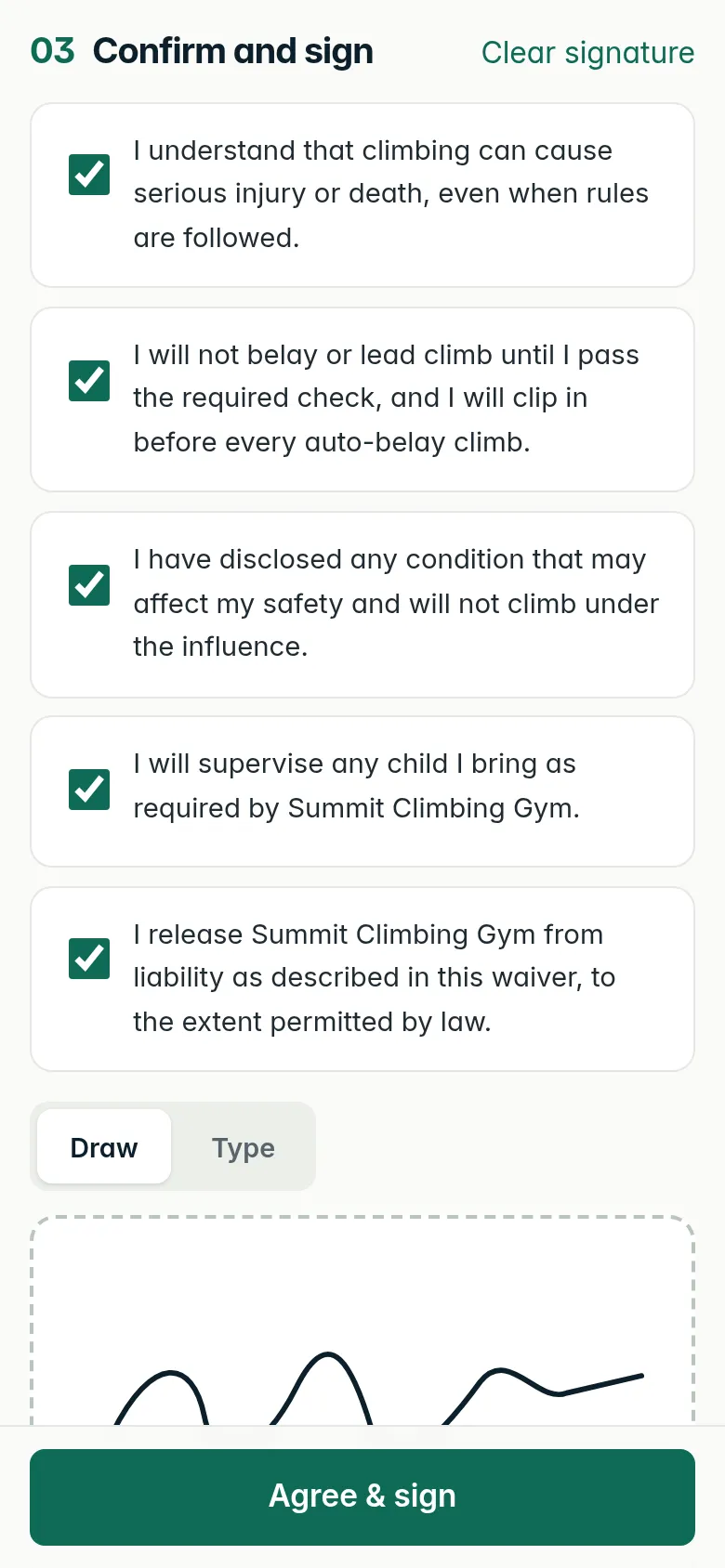
Collect signed waivers online
Customers sign on their phone, a QR code or a front-desk tablet. Every signature is stored as a PDF with an audit trail. Free for 25 signatures a month.
Start free