A hold harmless agreement is a contract in which one party promises not to hold another party legally responsible for losses, injuries or damage connected to a specific activity, property or job. Most hold harmless agreements also include an indemnity promise: if someone else sues, the signer covers the other party's costs. Businesses use them when they let contractors, renters, vendors or participants use their space, equipment or services.
The idea is simple: it moves risk from one party to the other in writing, before anything goes wrong. How much risk moves, and whether a court will honor it, depends on the wording and on the law of your state.
How a hold harmless agreement works
Every hold harmless agreement has two roles:
- The indemnitor: the party who makes the promise and takes on the risk. This is usually the contractor, renter, vendor or participant.
- The indemnitee: the party who is protected. This is usually the property owner, venue, equipment owner or business running the activity.
In practice the agreement does two jobs. First, it works as a release: the signer agrees not to sue the protected party for their own losses. Second, it works as an indemnity: if a third party (a guest, a customer, a passer-by) brings a claim that arises from the signer's activity, the signer agrees to defend the protected party or pay what it costs.
Here is a simple example. A yoga teacher rents a studio room on Sunday mornings to run her own classes. The studio asks her to sign a hold harmless agreement. If one of her students slips during her class and sues the studio, the agreement says the teacher handles that claim, because it came from her class, not from the studio's business.
Types of hold harmless agreements
There are two ways to classify these agreements: by who makes the promise, and by how much risk is transferred.
Unilateral vs reciprocal
A unilateral (one-way) agreement protects only one party. The contractor protects the owner, the renter protects the venue, and so on. This is the most common form for small businesses.
A reciprocal (mutual) agreement has both parties protect each other, usually for losses caused by their own side. It is common when two businesses of similar size work together, for example a caterer and an event venue, and neither wants to carry the other's risk.
Broad form, intermediate form and limited form
Insurance and construction professionals sort hold harmless clauses by how much fault they cover:
| Form | What the signer covers | Typical use |
|---|---|---|
| Broad form | Claims caused by the signer, by both parties together, and even by the protected party alone | Large construction contracts, where allowed |
| Intermediate form | Claims caused by the signer and claims where both parties share fault, but not the protected party's sole negligence | Commercial leases, subcontracts |
| Limited form | Only claims to the extent the signer (or its people) caused them | Small business rentals, vendors, events |
Broad form is the most protective for the business and the most likely to be challenged. Many states have anti-indemnity statutes, especially for construction contracts, that make broad form clauses void, and some restrict intermediate form clauses too. Limited form clauses are generally permitted. If you run a small business and are not sure which to use, a limited or intermediate form is usually the realistic choice, and a local attorney can confirm what your state allows.
Hold harmless agreement examples by industry
Hold harmless language shows up far outside construction. Some common situations:
- Event venues and halls: a customer rents the space for a private party and agrees to cover claims from their guests.
- Gyms and studios: an independent personal trainer or instructor uses the floor to train their own clients.
- Equipment rentals: a customer renting a boat, bikes, a bounce house or tools agrees to cover damage and third-party injuries during the rental. See the boat rental agreement and bounce house rental waiver.
- Vendors and pop-ups: a food truck or market stall operates on your property.
- Contractors: a handyman, cleaner or installer works on your premises.
- Volunteers and community groups: an outside group uses your facility for its own program. The volunteer waiver covers the volunteer side.
- Landlords and tenants: a lease clause makes the tenant responsible for claims arising inside the unit.
Hold harmless vs indemnity
The two terms are often used together ("hold harmless and indemnify"), and some courts treat them as meaning the same thing. Others read them differently:
| Hold harmless | Indemnify | |
|---|---|---|
| Core idea | Do not hold the other party responsible | Pay back or cover the other party's losses |
| Main protection | Against claims by the signer | Against claims by third parties |
| Includes legal defense? | Not by itself | Often, if "defend" is written in |
Because the distinction is not settled everywhere, well-drafted agreements spell out all three promises: to release, to indemnify and to defend. For a fuller comparison, read waiver vs release vs hold harmless.
Hold harmless agreement vs liability waiver
A liability waiver is usually signed by a customer or participant who is taking part in a risky activity, such as a climbing session or a trampoline park visit. Its main job is to release the business from the participant's own claims.
A hold harmless agreement is usually signed by someone who brings their own activity, people or business onto your property. Its main job is to shift responsibility for what that party and its guests do. In real life the two overlap, and many documents include both a release and a hold harmless clause.
How to write a hold harmless agreement
- Name the parties. Use full legal names of the business and the signer (and the signer's company, if any).
- Describe the activity precisely. "Use of the main hall and kitchen on June 14, 2027, including setup and teardown" is far stronger than "use of the premises." Courts read these agreements narrowly.
- Choose the scope. Decide on unilateral or reciprocal, and limited, intermediate or broad form, within what your state allows.
- Write the release. The signer gives up claims against the business for their own losses connected to the activity.
- Write the indemnity and defense promise. The signer covers third-party claims and legal costs arising from their activity.
- Add insurance requirements. For contractors and vendors, ask for a certificate of insurance and, if appropriate, to be named as an additional insured.
- Add the standard clauses. Severability, governing law and a statement that the signer read and understood the agreement.
- Make it conspicuous and get a signature. Use clear headings and plain words, and keep a dated, signed copy.
For more on the clause itself, with sample wording, see hold harmless clause explained.
What a hold harmless agreement cannot do
A hold harmless agreement is not a force field. In most states it will not protect a business from its own gross negligence, recklessness or intentional misconduct. Courts may also refuse to enforce it if the language is vague, hidden in fine print, signed under pressure, or contrary to public policy. Agreements signed by parents on behalf of children are treated differently from state to state (see can a parent sign a waiver for a child). It also does not replace insurance: if the signer has no money or coverage, the promise to indemnify may be worth little.
This guide is general information, not legal advice. Rules vary by state, so have a local attorney review your final agreement.
Collecting hold harmless agreements online
The weak point of most hold harmless agreements is not the wording, it is the paperwork: unsigned copies, missing dates, a folder nobody can find. With FairWaiver you can start from the free hold harmless agreement template, edit it for your business, and send it as a link or QR code. Each signed copy is stored with a timestamp and audit trail, and the free plan covers 25 signatures a month.
Frequently asked questions
What is the purpose of a hold harmless agreement?
Its purpose is to move the risk of a specific activity from one party to another. The signer agrees not to hold the protected party responsible for losses and, usually, to cover claims from third parties that arise from the signer's activity.
Who signs a hold harmless agreement?
The party taking on the risk signs it, such as a contractor, renter, vendor or participant. In a reciprocal agreement both parties sign and protect each other.
Is a hold harmless agreement legally binding?
It is a contract, so it is generally binding if it is clear, specific and signed voluntarily. Courts in many states will not enforce it for gross negligence or intentional misconduct, and some states limit broad form clauses by statute.
What is the difference between hold harmless and indemnify?
Hold harmless means not holding the other party responsible. Indemnify means paying back their losses, typically from third-party claims. Many agreements use both words, plus a duty to defend, to avoid any gap.
Do I need a lawyer for a hold harmless agreement?
You can start from a template, but a local attorney should review it, especially for construction work or high-risk activities, because state rules on indemnity differ.
Can a hold harmless agreement be signed electronically?
Yes. Under the federal ESIGN Act and state UETA laws, an electronic signature generally has the same legal effect as a handwritten one for this type of contract. Keep an audit trail that shows who signed and when.
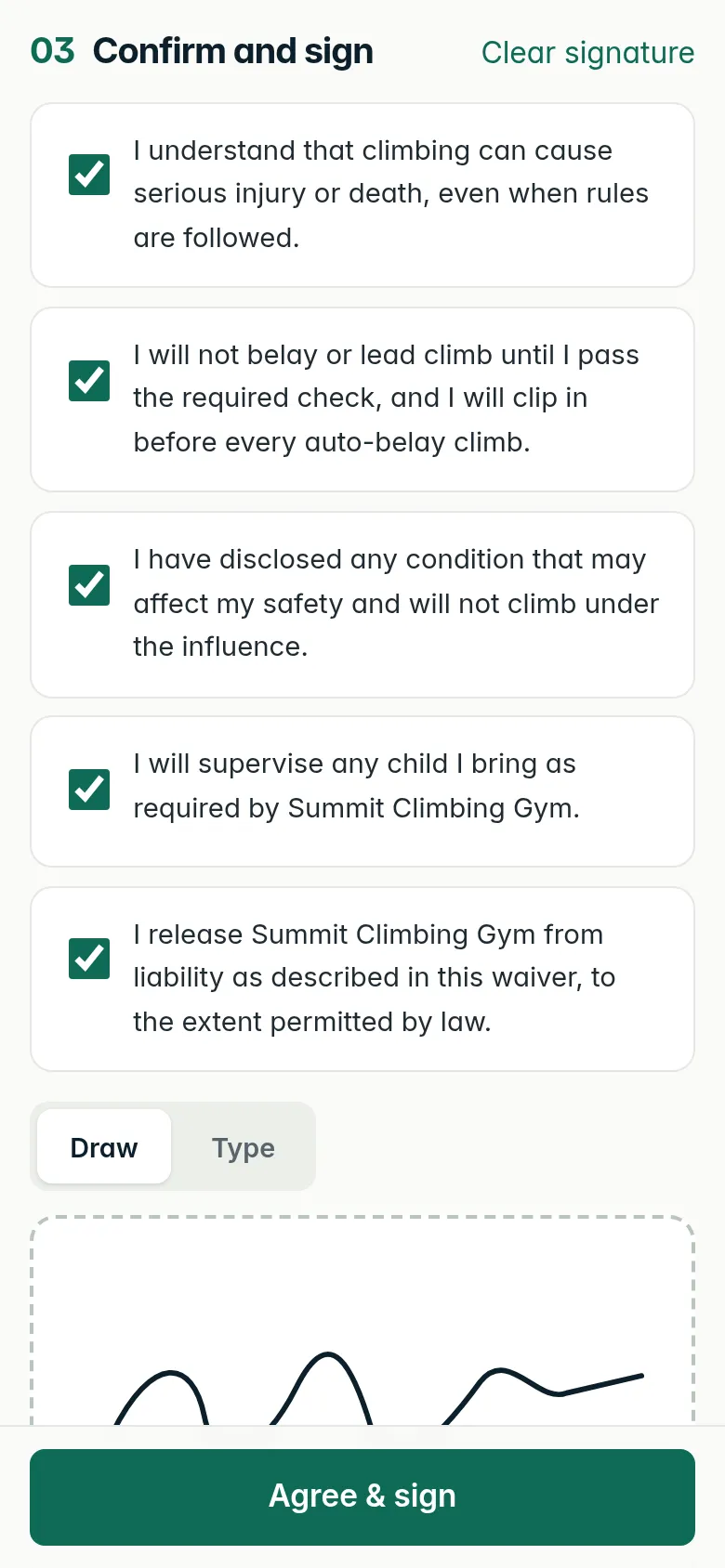
Collect signed waivers online
Customers sign on their phone, a QR code or a front-desk tablet. Every signature is stored as a PDF with an audit trail. Free for 25 signatures a month.
Start free