Waxing studios, salons, spas and brow bars all benefit from a consistent consent form. It is especially important for facial waxing and intimate services such as Brazilian and bikini waxes, where skin is more sensitive and clients may feel anxious.
What this template covers
- Description of hard and soft wax services
- Contraindications: retinoids, isotretinoin, antibiotics, peels, sunburn, diabetes
- Risks: redness, skin lifting, burns, bruising, ingrown hairs, folliculitis
- Intimate waxing privacy and comfort
- Aftercare instructions and responsibility
- Cancellation and conduct policies
Tips for estheticians
Ask about medications at every visit, not only the first, because clients start new prescriptions and skincare products without thinking about waxing. Many estheticians follow industry guidance to avoid waxing anyone who has taken isotretinoin within the past six months or longer, and to avoid areas treated with topical retinoids for several days; follow your training and product manufacturer's guidelines.
Always test wax temperature on your own wrist and do a small patch on the client before full application, especially for first-time clients. Let clients know what to expect during intimate waxing and that they can pause or stop at any time. Rules for estheticians vary by state licensing board, so check your local requirements.
With FairWaiver, clients complete the consent on their phone before they arrive and confirm their medications at each visit with a quick update.
Collect it online in three steps
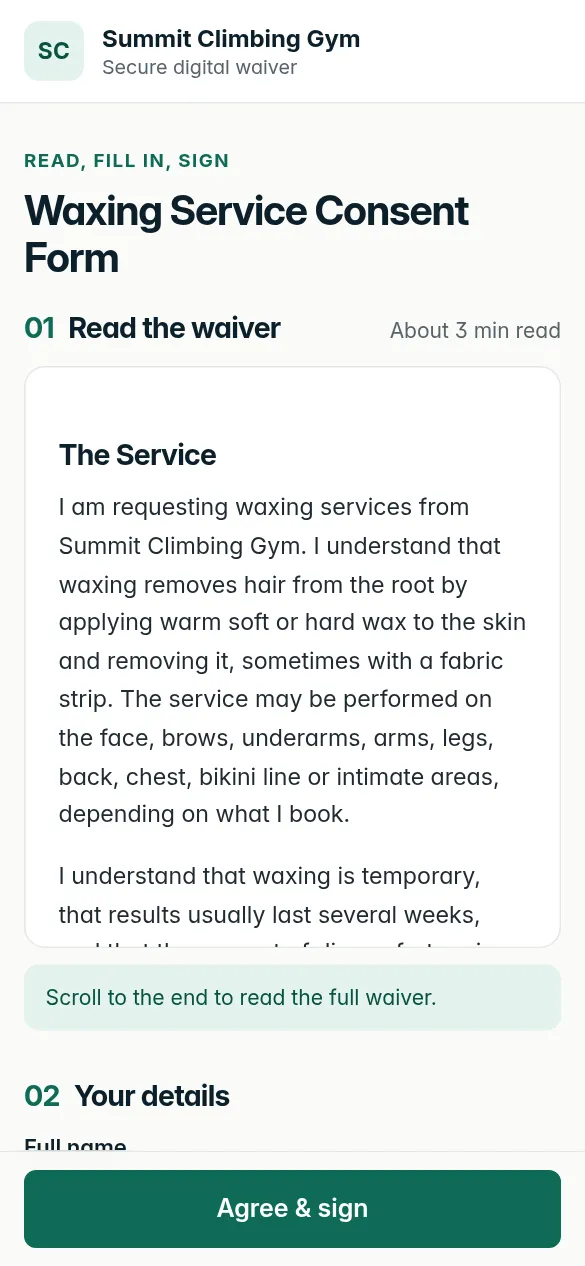
- Start from this template. Add your business name and logo, change any wording, and choose what to collect: date of birth, emergency contact, children's names or your own questions.
- Share it. Send the link with booking confirmations, print the QR poster for your door, embed it on your website, or put a tablet at the front desk in kiosk mode.
- Every signature is filed. Customers sign with a finger on their phone. You get a PDF with the exact text they agreed to, the time, the device and a tamper-evident fingerprint, and they get a copy by email.
Waxing Service Consent Form: full template
Waxing Service Consent Form
The Service
I am requesting waxing services from [Business Name]. I understand that waxing removes hair from the root by applying warm soft or hard wax to the skin and removing it, sometimes with a fabric strip. The service may be performed on the face, brows, underarms, arms, legs, back, chest, bikini line or intimate areas, depending on what I book.
I understand that waxing is temporary, that results usually last several weeks, and that the amount of discomfort varies from person to person and from area to area.
Medications and Skin Conditions
I understand that certain medications, products and conditions make the skin more fragile and can cause the skin to lift, tear or burn during waxing. I confirm that I have told my esthetician if I currently use or have recently used any of the following:
- isotretinoin (such as Accutane, Absorica or Claravis), in the past [6–12] months;
- topical retinoids or retinol (such as Retin-A, tretinoin, adapalene or Differin);
- prescription acne medications, topical antibiotics, or oral antibiotics such as tetracycline;
- steroid creams, blood thinners or other medication that affects skin or bleeding;
- chemical peels, microdermabrasion, laser treatments, microneedling or dermaplaning in the past few weeks; or
- facial hair bleach or depilatory creams in the past few days.
I have also told my esthetician if I have diabetes, poor circulation, varicose veins, eczema, psoriasis, rosacea, a skin infection, cold sores, open wounds, moles or skin tags in the area, a recent sunburn, or am pregnant. I understand that some of these conditions mean that waxing must be modified or cannot be performed on certain areas.
I will update [Business Name] before every appointment if my medications, skincare products or health change.
Risks
I understand that waxing can cause:
- temporary redness, swelling, tenderness and small bumps;
- minor bleeding or pinpoint spots, particularly on coarse hair or sensitive areas;
- skin lifting or tearing, especially if I have not disclosed relevant medications;
- burns if the wax is too warm for my skin;
- bruising, particularly on thin or loose skin;
- ingrown hairs, folliculitis (inflamed hair follicles) or breakouts;
- allergic reactions to wax, resin, pre- or post-wax products; and
- temporary darkening or lightening of the skin, especially on darker skin tones.
Intimate Waxing
If I am receiving a bikini, Brazilian or other intimate wax, I understand that my esthetician will explain the process, provide coverings, and keep me as comfortable and covered as possible. I can ask to pause or stop at any time. I understand that the service is strictly professional and that any inappropriate behavior will end the service immediately, with the full price charged.
Aftercare
I have received aftercare instructions. I understand that for at least 24 to 48 hours after waxing I should avoid hot baths, saunas, steam rooms, swimming pools, tanning, intense exercise, tight clothing over waxed areas, and fragranced or exfoliating products. I will exfoliate gently and moisturize after the first few days to reduce ingrown hairs. I will contact [Business Name] if I have a reaction, and seek medical advice for any burn, blistering or signs of infection.
No Guarantee
I understand that hair regrowth and results vary depending on hair type, hormones, medications and how regularly I wax, and that [Business Name] does not guarantee any specific result.
Cancellation
I agree to give at least [24] hours' notice to cancel or reschedule. Late cancellations and missed appointments may be charged [a fee / the full service price]. Hair should be at least about [1/4 inch] long for best results, and services may need to be rescheduled if hair is too short.
Consent and Release
I consent to receive waxing services from [Business Name]. To the fullest extent permitted by law, I release [Business Name], its owners and staff from claims arising from reactions or injuries caused by information I did not disclose or by the known risks described above, except claims caused by gross negligence or willful misconduct. This consent is governed by the laws of the state or country in which [Business Name] operates.
Acknowledgements (signer ticks each)
- I have disclosed all medications and skincare products, including retinoids, isotretinoin and antibiotics.
- I understand waxing can cause redness, skin lifting, burns, bruising and ingrown hairs.
- I will tell [Business Name] before every appointment if my medications or health change.
- I have received aftercare instructions and accept responsibility for following them.
- I am at least 18 years old, or a parent or legal guardian is consenting on my behalf.
Replace “[Business Name]” with your business name, FairWaiver does this automatically. This template is general information, not legal advice. Laws vary by state, so have a local attorney review it.
Frequently asked questions
Why do waxing salons ask about Accutane and retinoids?
Isotretinoin (Accutane) and topical retinoids thin the outer layer of the skin, so wax can remove skin along with the hair, leaving painful wounds that may scar. Many estheticians will not wax a client who has used isotretinoin within the past six months or more, or areas treated with retinoids recently.
Is a waxing consent form legally required?
There is usually no specific law requiring one, but state esthetics boards expect licensed professionals to screen clients, and insurers often recommend written consent. A form documents that the client disclosed medications and understood the risks.
How long should I wait to wax after a chemical peel or laser treatment?
Waiting periods depend on the treatment and the products used, but estheticians commonly wait at least one to two weeks, and longer for stronger peels. Follow your training, product manufacturer guidance and the treating provider's advice.
Can you get waxed while pregnant?
Many people wax safely during pregnancy, though skin can be more sensitive and prone to irritation. Clients should tell their esthetician they are pregnant, and some may prefer to consult their healthcare provider first.
Can a minor get waxed?
Many salons wax minors, such as for eyebrows, with consent from a parent or legal guardian, and some require a parent to be present for certain services. Check your state's rules and your salon's policy, particularly for intimate waxing.