For massage therapists it is both a safety tool and a professional record. It helps you spot contraindications such as blood clots, recent surgery or pregnancy, and it documents that the client agreed to the treatment, to draping and to your professional boundaries.
Who needs a massage intake form
- Independent and mobile massage therapists
- Day spas, wellness centers and hotel spas
- Chiropractic and physical therapy offices that offer massage
- Sports massage and recovery studios
Many state massage boards expect licensed therapists to keep client records, and the intake form is the foundation of those records.
What this massage intake form template covers
- The purpose of massage and its limits (no diagnosis or prescribing)
- Reason for the visit, pressure preference and areas to focus on or avoid
- A health checklist covering common contraindications and medications
- Draping, communication and the client's right to stop at any time
- A professional conduct and boundaries statement
- Minors, who need a parent or guardian's consent
- Cancellation and late-arrival policy blanks
- A privacy statement for client records and a limited release
How to use it
- Fill in your cancellation notice and fee in the bracketed blanks.
- Send the form with the booking confirmation, so clients can answer at home with their medication list at hand.
- Read the answers before the session and spend a few minutes reviewing them with the client.
- Note pressure preference and areas to avoid, and adjust the session plan.
- Ask returning clients to update the form at least once a year or when their health changes.
Tips for therapists
If a client reports a possible deep vein thrombosis, uncontrolled high blood pressure, a recent heart event or an acute injury, consider asking for clearance from their physician before proceeding. For pregnancy, follow your prenatal training and positioning guidelines. A simple body diagram question, where clients mark areas of pain, saves time in the treatment room.
Keep your scope of practice clear: massage therapists generally do not diagnose or prescribe, and your form should say so. Rules on record keeping and scope vary by state, so check your licensing board's requirements, and have an attorney review the release wording. This form is not a HIPAA compliance tool, so if you bill health insurance, check what HIPAA requires of you.
With FairWaiver the massage intake form goes out with the booking confirmation, you read the client's answers before they arrive, and you can flag important answers, such as a reported blood clot, so they stand out and reach you by email.
Collect it online in three steps
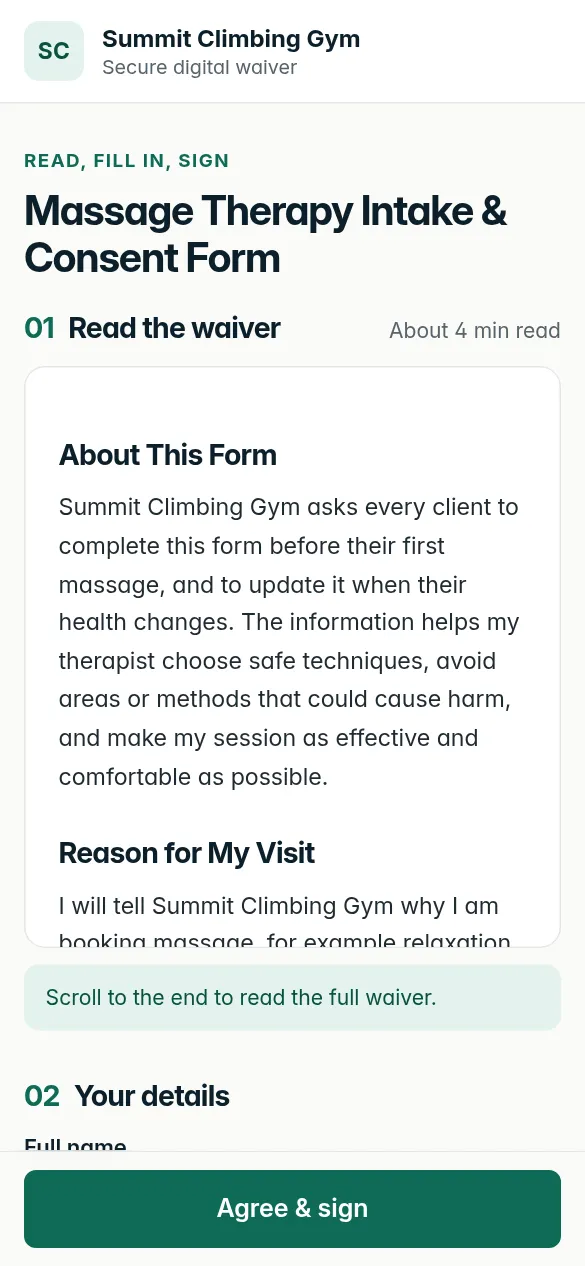
- Start from this template. Add your business name and logo, change any wording, and choose what to collect: date of birth, emergency contact, children's names or your own questions.
- Share it. Send the link with booking confirmations, print the QR poster for your door, embed it on your website, or put a tablet at the front desk in kiosk mode.
- Every signature is filed. Customers sign with a finger on their phone. You get a PDF with the exact text they agreed to, the time, the device and a tamper-evident fingerprint, and they get a copy by email.
Massage Therapy Intake & Consent Form: full template
Massage Therapy Intake & Consent Form
About This Form
[Business Name] asks every client to complete this form before their first massage, and to update it when their health changes. The information helps my therapist choose safe techniques, avoid areas or methods that could cause harm, and make my session as effective and comfortable as possible.
Reason for My Visit
I will tell [Business Name] why I am booking massage, for example relaxation, muscle tension, recovery from activity, or a specific area of discomfort, and whether I have had professional massage before. I will share my preferred pressure (light, medium or firm) and any areas I want my therapist to focus on or avoid.
Health Information
I understand that massage may not be appropriate, or may need to be modified, if I have certain conditions. I have disclosed whether I currently have or have recently had:
- blood clots, deep vein thrombosis, varicose veins or a bleeding disorder;
- high or low blood pressure, heart disease or a pacemaker;
- recent surgery, fractures, sprains or other injuries;
- cancer or current cancer treatment;
- diabetes, neuropathy or reduced sensation;
- arthritis, osteoporosis, disc problems or joint replacements;
- headaches, migraines, dizziness or recent head injury;
- skin conditions, rashes, open wounds, sunburn or contagious illness;
- fever, flu-like symptoms or recent infection;
- allergies to oils, lotions, nuts, fragrances or latex; and
- pregnancy, including the current stage of pregnancy.
I have listed the medications I take, including blood thinners and pain relievers, since these can affect how my body responds to pressure. I will tell my therapist before each session if anything has changed.
Scope of Practice
I understand that massage therapy is provided for relaxation, relief of muscle tension and general well-being. My therapist does not diagnose illness or injury, prescribe medication, or perform spinal adjustments, and massage is not a substitute for medical examination or treatment. If I have a medical condition, I will follow my physician's advice, and I understand that [Business Name] may ask for written clearance before treating me.
Consent to Treatment
I consent to receive massage therapy from [Business Name]. I understand that:
- I will be properly draped at all times, and only the area being worked on will be uncovered;
- I may keep on any clothing I prefer, and the session will be adapted;
- I can ask my therapist to change pressure, technique or room temperature, or skip any area, at any time;
- I may end the session at any time for any reason; and
- some soreness for a day or two after deep or focused work is normal.
Professional Conduct
I understand that massage at [Business Name] is strictly professional and therapeutic. Any sexual comments, requests or behavior by a client will result in the session ending immediately, with full payment due, and may be reported. My therapist may also end a session if they believe it is unsafe to continue.
Minors
If the client is under 18, I am their parent or legal guardian, I consent to the massage on their behalf, and I will be present or available during the session as required by [Business Name] and local rules.
Emergency
If I become unwell during a session, I authorize [Business Name] to provide first aid, contact my emergency contact and call emergency services. I am responsible for any resulting costs.
Cancellation Policy
I agree to give at least [24] hours' notice to cancel or change my appointment. Late cancellations and missed appointments may be charged [50% / 100%] of the session price. If I arrive late, my session may end at the scheduled time and the full price will apply.
Privacy
[Business Name] will keep my intake information and session notes confidential. They will be used only to provide my care, will be stored securely, and will not be shared without my written consent unless required by law or in an emergency. I may ask to see or correct the information I have provided.
Release
I understand that massage carries small risks, such as soreness, bruising, light-headedness or allergic reaction to products. To the extent permitted by law, I release [Business Name] and its therapists from liability for injuries that arise from information I failed to disclose or from inherent risks of massage, except in cases of gross negligence or willful misconduct. This form is governed by the laws of the state or country in which [Business Name] operates. If any part is unenforceable, the rest remains in effect, and an electronic signature on this form has the same effect as a handwritten one.
Acknowledgements (signer ticks each)
- I have provided complete and accurate health information and will tell my therapist if anything changes.
- I understand massage is not a substitute for medical care and my therapist does not diagnose or prescribe.
- I understand I can ask to change or stop the session at any time.
- I agree to the cancellation and professional conduct policies of [Business Name].
Replace “[Business Name]” with your business name, FairWaiver does this automatically. This template is general information, not legal advice. Laws vary by state, so have a local attorney review it.
Frequently asked questions
What is a massage intake form?
A massage intake form is a questionnaire and consent form a client completes before their first massage. It records their health history, medications, pressure preference and areas to avoid, and their consent to treatment, draping and the therapist's policies.
What should be on a massage intake form?
A typical form covers contact and emergency details, the reason for the visit, health history and medications, allergies, pressure and focus preferences, consent to treatment, draping and conduct policies, and a cancellation policy. Some therapists also add a body diagram for marking areas of pain.
What is the difference between a massage intake form and a massage consent form?
The intake part collects health history and preferences, and the consent part records that the client agrees to treatment, draping and your policies. Most practices combine both in one form, as this template does.
Are massage therapists required to keep intake forms?
Many state massage boards require licensed therapists to keep client records for a set number of years, and an intake form is usually part of that record. Requirements vary, so check your state board's rules on what to document and how long to keep it.
What are common contraindications for massage?
Common contraindications include blood clots, fever or contagious illness, acute injuries, recent surgery, certain heart conditions and skin infections. Others, like pregnancy or diabetes, usually mean the massage should be adapted rather than avoided. When in doubt, ask for physician clearance.
Can I massage a pregnant client?
Many therapists offer prenatal massage with specialized positioning, often after the first trimester and sometimes with physician approval for high-risk pregnancies. Ask about pregnancy on your intake form and follow your training and professional guidelines.
Can clients fill out a massage intake form online?
Yes. Online intake forms let clients answer at home with their medication lists on hand, and they give you time to review before the session. In the US, electronic signatures are generally valid under the ESIGN Act and state electronic transaction laws.