This template is built for day spas, skincare studios, estheticians, salons and med spas offering facials. It works as a general consent that covers your facial menu, with space to note which specific treatments the client receives.
What this template covers
- A description of common facial treatments and techniques
- Skin history: acne medications, retinoids, recent procedures, sensitivities
- Contraindications for peels, exfoliation and electrical devices
- Risks: redness, purging, irritation, hyperpigmentation, allergic reaction
- Sun protection and aftercare responsibilities
- Scope of practice and no guarantee of results
Tips for estheticians
Do a proper skin consultation before the first facial and record what you see: skin type, sensitivity, active breakouts and any areas to avoid. Ask about medications and skincare at every visit, since a new retinoid or a recent laser treatment can change what is safe. Patch test new products on sensitive clients.
Be careful with scope. Estheticians generally treat the outer layers of the skin; diagnosing skin disease, treating medical conditions or performing deeper procedures is usually reserved for licensed medical providers, and the line differs by state. If you see a suspicious mole or a skin condition that needs medical attention, refer the client. Check your state board's rules on peels, devices and dermaplaning.
With FairWaiver, clients complete their skin history before the appointment, so your consultation can focus on their goals instead of paperwork.
Collect it online in three steps
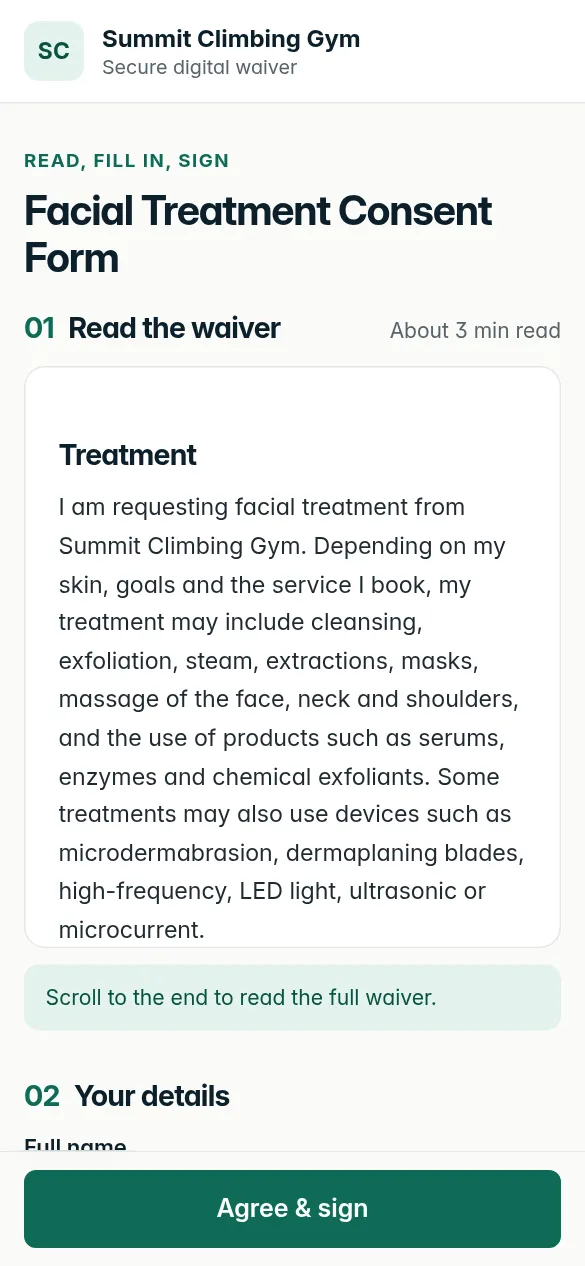
- Start from this template. Add your business name and logo, change any wording, and choose what to collect: date of birth, emergency contact, children's names or your own questions.
- Share it. Send the link with booking confirmations, print the QR poster for your door, embed it on your website, or put a tablet at the front desk in kiosk mode.
- Every signature is filed. Customers sign with a finger on their phone. You get a PDF with the exact text they agreed to, the time, the device and a tamper-evident fingerprint, and they get a copy by email.
Facial Treatment Consent Form: full template
Facial Treatment Consent Form
Treatment
I am requesting facial treatment from [Business Name]. Depending on my skin, goals and the service I book, my treatment may include cleansing, exfoliation, steam, extractions, masks, massage of the face, neck and shoulders, and the use of products such as serums, enzymes and chemical exfoliants. Some treatments may also use devices such as microdermabrasion, dermaplaning blades, high-frequency, LED light, ultrasonic or microcurrent.
My esthetician will explain the steps of my treatment before starting. I may ask questions, ask to skip any step, or stop the treatment at any time.
Skin History and Health
I have answered the skin and health questions truthfully and completely, including whether I:
- use or have recently used isotretinoin (such as Accutane), topical retinoids, retinol, prescription acne medication, hydroquinone, or exfoliating acids;
- have had Botox, fillers, laser treatments, microneedling, chemical peels, waxing or other skin procedures recently, or plan to soon;
- have sensitive skin, rosacea, eczema, psoriasis, dermatitis, active acne, cold sores, or a history of hyperpigmentation or keloid scarring;
- have allergies to skincare ingredients, fragrances, nuts, aspirin (relevant to salicylic acid), latex or other substances;
- am pregnant or breastfeeding;
- have a pacemaker, metal implants, epilepsy or a heart condition, which may affect the use of electrical devices; or
- have had recent sun exposure, sunburn or self-tanner use.
I understand that some treatments cannot be performed, or must be modified, if any of these apply, and that [Business Name] may decline a service it considers unsuitable for my skin.
I will tell my esthetician before every appointment about any changes in my medications, skincare routine, procedures or health.
Possible Reactions
I understand that facial treatments may cause:
- temporary redness, warmth, tightness or mild stinging;
- swelling, small marks or slight bruising after extractions;
- dryness, flaking or peeling, particularly after peels or exfoliation;
- breakouts or "purging" as the skin responds to treatment;
- irritation or allergic reactions to products;
- in rare cases, burns, blistering, scarring, infection or changes in skin color, especially after peels or on darker skin tones; and
- small nicks from dermaplaning.
Aftercare
I have received aftercare instructions and agree to follow them. I understand that for the period my esthetician advises, I should avoid direct sun exposure and tanning, use broad-spectrum sunscreen daily, avoid picking or peeling skin, and pause exfoliants, retinoids and other active products. I understand that sweating heavily, saunas, swimming and makeup may need to be avoided for a short time after certain treatments. If I have a reaction that worsens or does not settle, I will contact [Business Name] and seek medical advice if needed.
Scope and Results
I understand that facial treatments at [Business Name] are cosmetic and are not a substitute for medical care. My esthetician does not diagnose or treat medical skin conditions, and may recommend I see a dermatologist or physician. I understand that results vary based on my skin type, lifestyle, home care and consistency, that several treatments may be needed to see a change, and that [Business Name] does not guarantee specific results.
Photos
I consent to [Business Name] taking before and after photos of my skin for my client record. [Business Name] will not use these photos publicly without my separate written consent.
Cancellation
I agree to give [24] hours' notice to cancel or reschedule. Late cancellations and missed appointments may be charged [a fee / the full service price].
Consent and Release
I consent to receive facial treatments from [Business Name]. To the fullest extent permitted by law, I release [Business Name], its owners and staff from claims arising from reactions caused by information I did not disclose, from the possible reactions described above, or from my failure to follow aftercare, except claims caused by gross negligence or willful misconduct. This consent applies to all facial treatments I receive from [Business Name] and is governed by the laws of the state or country in which [Business Name] operates.
Acknowledgements (signer ticks each)
- I have disclosed my full skin history, medications, recent procedures and allergies.
- I understand facial treatments may cause redness, peeling, breakouts or, rarely, burns or pigment changes.
- I will avoid sun exposure and follow the aftercare instructions provided.
- I understand results vary and [Business Name] does not diagnose or treat medical skin conditions.
- I will update [Business Name] before each appointment if my medications or health change.
Replace “[Business Name]” with your business name, FairWaiver does this automatically. This template is general information, not legal advice. Laws vary by state, so have a local attorney review it.
Frequently asked questions
Why do I need a consent form for a facial?
Facials can involve active products and techniques, such as peels, extractions and exfoliation, that can cause reactions in some skin types or when combined with certain medications. A consent form records that the client shared their history and understood the risks.
What are common contraindications for facials?
Common contraindications include recent isotretinoin use, topical retinoids before peels or exfoliation, active skin infections or cold sores, recent laser or injectable treatments, sunburn and certain allergies. Pregnancy and electrical implants may limit some treatments. Follow your training and product guidelines.
Can estheticians perform chemical peels?
In many states, licensed estheticians can perform superficial peels, while medium and deep peels are reserved for medical providers. The rules vary by state, so check your licensing board's scope of practice.
How often should clients update their facial consent form?
Many estheticians have clients re-sign or update their consent annually and do a quick check of medications and recent treatments at every visit. Any significant change, such as starting a new prescription, should be recorded right away.
Are before and after photos allowed?
Before and after photos are useful for tracking progress and are common in skincare. Keep them in the client's private record and get separate written consent before using them in marketing.