This template suits piercing studios and tattoo shops, for adult clients and for minors whose parents are present where local law allows.
What this template covers
- Procedure description: sterile single-use needle, initial jewelry and swelling
- Health screening: pregnancy, blood thinners, diabetes, metal allergies, keloids
- Risks: infection, migration and rejection, irritation bumps, nerve and tooth damage
- Healing times and why jewelry should not be changed early
- Aftercare, downsizing and follow-up checks
- Parental consent and identification for minors
Tips for piercers
Verify age with photo ID for every client, and for minors, verify the parent's ID and relationship as your local regulations require, which may include a birth certificate or court documents for guardians. Use implant-grade jewelry such as titanium, niobium or solid gold and note the material on the record. Explain that initial jewelry is longer to allow for swelling and that a downsize visit is part of good healing.
Talk through realistic healing times: an earlobe may heal in a couple of months, while cartilage, navel and surface piercings can take many months or longer. Clients who change jewelry too early are the most common source of complications. Check your state and county rules, since some ban certain piercings for minors entirely.
With FairWaiver, clients and parents can complete the consent on their phones while waiting, and you keep a timestamped, inspection-ready record of every procedure.
Collect it online in three steps
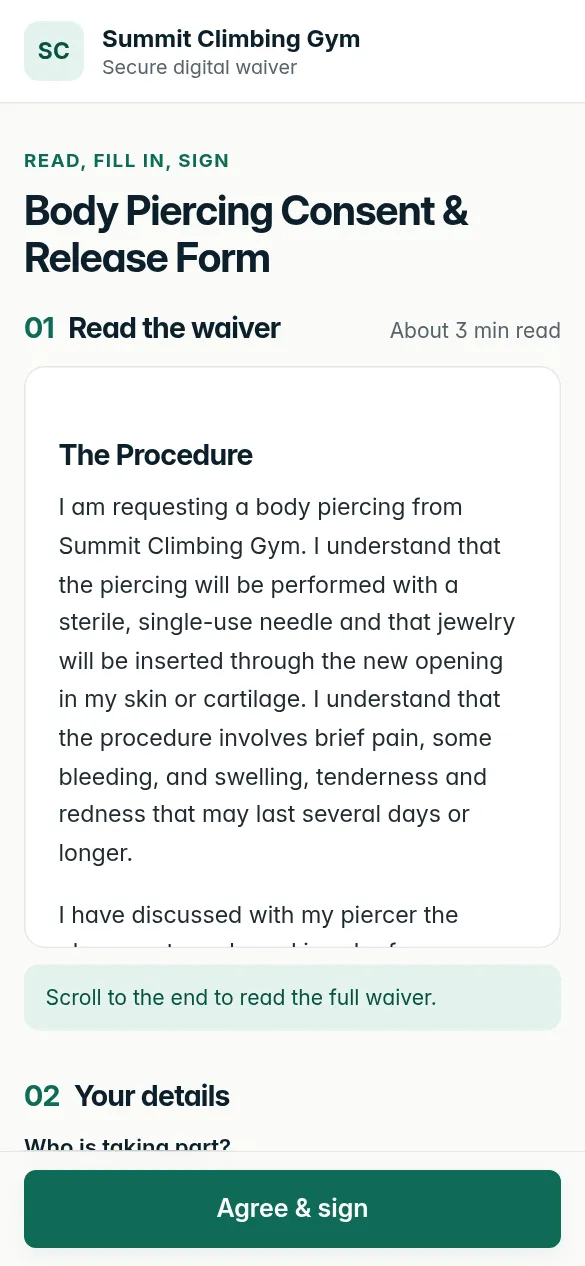
- Start from this template. Add your business name and logo, change any wording, and choose what to collect: date of birth, emergency contact, children's names or your own questions.
- Share it. Send the link with booking confirmations, print the QR poster for your door, embed it on your website, or put a tablet at the front desk in kiosk mode.
- Every signature is filed. Customers sign with a finger on their phone. You get a PDF with the exact text they agreed to, the time, the device and a tamper-evident fingerprint, and they get a copy by email.
Body Piercing Consent & Release Form: full template
Body Piercing Consent & Release Form
The Procedure
I am requesting a body piercing from [Business Name]. I understand that the piercing will be performed with a sterile, single-use needle and that jewelry will be inserted through the new opening in my skin or cartilage. I understand that the procedure involves brief pain, some bleeding, and swelling, tenderness and redness that may last several days or longer.
I have discussed with my piercer the placement, angle and jewelry for my piercing, and I approve them. I understand that my anatomy may make some placements unsuitable, and that my piercer may recommend a different placement or decline to perform a piercing.
Jewelry
I understand that [Business Name] uses jewelry made of implant-grade materials suitable for initial piercings. Initial jewelry is often longer or larger to allow for swelling, and I may need to return for a shorter post ("downsizing") once the swelling goes down. I understand that changing my jewelry before the piercing has healed, or replacing it with low-quality jewelry, increases my risk of complications.
Health Disclosure
I have answered the health questions truthfully. I have told my piercer if I:
- am pregnant or breastfeeding;
- have diabetes, hemophilia or another bleeding disorder, heart conditions, epilepsy or an immune-compromising condition;
- take blood thinners, steroids or other medication that affects bleeding or healing;
- have allergies to metals (such as nickel), latex, antiseptics or soaps;
- have a history of keloids, hypertrophic scarring or poor wound healing; or
- have a skin condition, rash, sunburn or infection at or near the piercing site.
I confirm I am not under the influence of alcohol or drugs and have eaten recently.
Risks
I understand that, even when the piercing is performed correctly with sterile equipment, risks include:
- local infection, which may require medical treatment, and, rarely, more serious infection;
- allergic reaction to the jewelry material or aftercare products;
- irritation bumps, hypertrophic scarring or keloids;
- migration or rejection, where the body pushes the jewelry toward the surface;
- jewelry being caught, torn or embedded if swelling exceeds the jewelry's length;
- for oral piercings, damage to teeth and gums and swelling of the tongue;
- for facial piercings, minor nerve irritation or temporary numbness; and
- fainting or light-headedness during or after the procedure.
Healing and Aftercare
I have received written aftercare instructions and agree to follow them. I understand that healing times vary widely, from several weeks for some earlobe piercings to many months for cartilage, navel and surface piercings, and that a piercing can look healed on the outside before it has healed inside. During healing I will clean the piercing as instructed, avoid touching it with unwashed hands, avoid pools, hot tubs, lakes and the ocean, and avoid sleeping on it or snagging it on clothing. If I notice signs of infection, such as spreading redness, heat, thick yellow or green discharge, fever or red streaks, I will contact a doctor and will not remove the jewelry unless a doctor advises it, as this can trap an infection.
No Guarantee
I understand that every body heals differently and that [Business Name] cannot guarantee how my piercing will heal, look or last.
Age and Identification
I confirm that I am at least 18 years old and have shown valid photo identification, or that I am a minor whose parent or legal guardian is present, has shown identification and proof of relationship as required, and consents to this piercing on my behalf.
Release
I voluntarily accept the risks of body piercing. To the fullest extent permitted by law, I release [Business Name], its owners, piercers and staff from claims for injury, illness or dissatisfaction arising from the procedure or healing, except claims caused by gross negligence or willful misconduct. This consent is governed by the laws of the state or country in which [Business Name] operates. If any part is unenforceable, the rest remains in effect.
Acknowledgements (signer ticks each)
- I am at least 18 years old, or my parent or legal guardian is present and consents on my behalf.
- I have disclosed all relevant health conditions, allergies and medications.
- I approve the placement and jewelry for my piercing.
- I have received aftercare instructions and understand healing can take many months.
- I understand the risks of piercing and release [Business Name] as described, to the extent permitted by law.
Replace “[Business Name]” with your business name, FairWaiver does this automatically. This template is general information, not legal advice. Laws vary by state, so have a local attorney review it.
Frequently asked questions
Is a piercing consent form required by law?
Many US states and local health departments require piercing studios to obtain written consent and verify the client's age before every procedure, and to keep records for a set period. Rules vary by location, so check with your local health department and have an attorney review your form.
Can a minor get a piercing with parental consent?
In many states, minors can be pierced with a parent or legal guardian present who signs the consent. Some states restrict certain piercings, such as genital or nipple piercings, for minors regardless of consent, and some require additional proof of guardianship. Check local law before piercing a minor.
How long does a piercing take to heal?
Healing times vary by location and person. Earlobes often heal in about six to eight weeks, while cartilage, navel and surface piercings may take six months to a year or more. Changing jewelry too early is a common cause of complications.
What jewelry is best for a new piercing?
Many professional piercers recommend implant-grade titanium, niobium or solid 14k or 18k gold for initial piercings, because these materials are less likely to cause allergic reactions. Avoid jewelry with unknown metal content, especially if the client is sensitive to nickel.
Should an infected piercing be removed?
Medical professionals often advise leaving the jewelry in while treating a mild infection, as removing it can allow the hole to close and trap the infection. Clients should see a doctor for signs of infection and follow their advice.