Chemical services cause most salon disputes. Hair dye containing PPD can trigger allergic reactions, bleach can cause breakage or scalp burns on over-processed hair, and box dye or henna underneath can react unpredictably with salon products. Clients also often expect to go from dark to platinum in one visit. A consent form that covers hair history and expected results protects the stylist and helps the client make an informed decision.
What this template covers
- Allergies, scalp conditions and previous reactions to hair dye
- Hair history: box dye, henna, previous chemical services and extensions
- Patch test and strand test, and the client's choice to decline
- Risks of color, lightening, perms, relaxers and smoothing treatments
- Expected results, multiple sessions and no guarantee
- Aftercare, redo policy and release of liability
Tips for salon owners
Ask new color clients to come in for a patch test 48 hours before their first service, as most hair dye manufacturers recommend, and record the result or the client's decision to decline. For big changes, such as heavy lightening or color correction, do a strand test and explain that it may take more than one appointment to reach the goal.
Take the hair history seriously. Box dye, metallic salts and henna can react with lightener, and previous relaxers limit what is safe to do. Ask the questions on the form, and take before photos so there is a clear record of the starting point.
Keratin and smoothing treatments can release formaldehyde when heated. Follow the product's safety data sheet, ventilate the room and tell clients what to expect. State cosmetology boards set licensing and sanitation rules, so check yours. A salon consent form is not a substitute for proper technique, and a local attorney can review the final text.
With FairWaiver, clients sign on their phone before the appointment, you can ask for a photo of their current hair, and the signed form stays on file for every return visit.
Collect it online in three steps
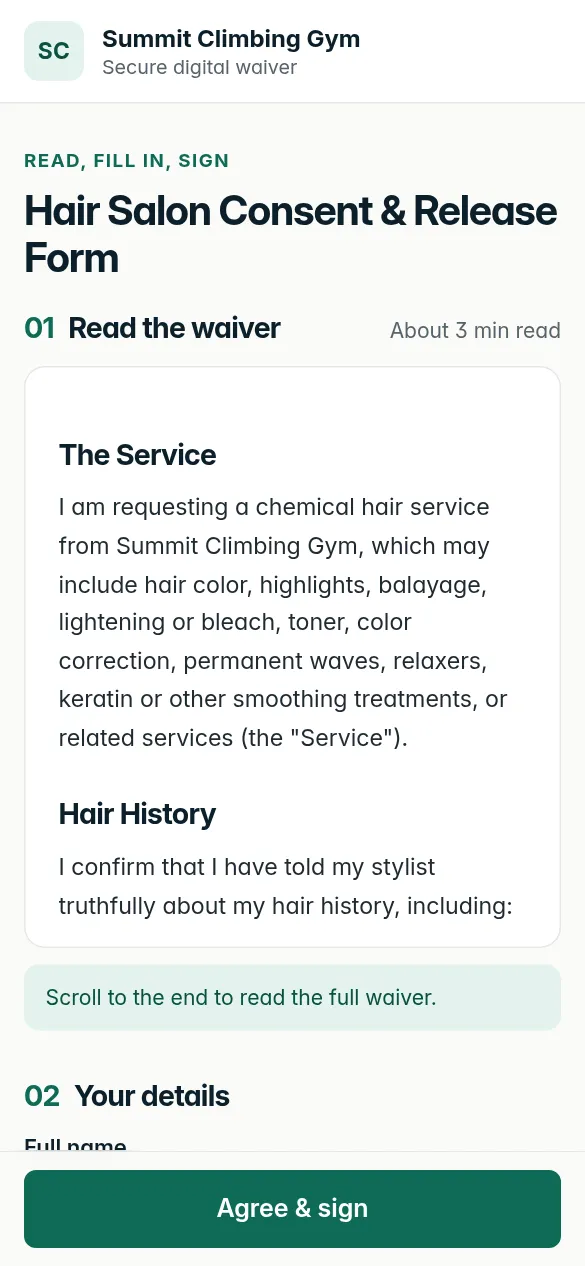
- Start from this template. Add your business name and logo, change any wording, and choose what to collect: date of birth, emergency contact, children's names or your own questions.
- Share it. Send the link with booking confirmations, print the QR poster for your door, embed it on your website, or put a tablet at the front desk in kiosk mode.
- Every signature is filed. Customers sign with a finger on their phone. You get a PDF with the exact text they agreed to, the time, the device and a tamper-evident fingerprint, and they get a copy by email.
Hair Salon Consent & Release Form: full template
Hair Salon Consent & Release Form
The Service
I am requesting a chemical hair service from [Business Name], which may include hair color, highlights, balayage, lightening or bleach, toner, color correction, permanent waves, relaxers, keratin or other smoothing treatments, or related services (the "Service").
Hair History
I confirm that I have told my stylist truthfully about my hair history, including:
- box dye, henna, color-depositing products or metallic dyes used in the past two years;
- previous lightening, perms, relaxers, keratin or smoothing treatments;
- hair extensions, and any recent hair loss, breakage or damage; and
- any service I had at another salon in the past six months.
I understand that inaccurate or incomplete hair history can cause unexpected results, breakage or damage, and that [Business Name] is not responsible for results caused by information I did not disclose.
Health and Allergies
I confirm that I have disclosed any of the following that apply to me:
- allergies to hair dye, PPD, ammonia, latex, fragrances or other chemicals;
- previous reactions to hair color, including black henna tattoos;
- scalp conditions such as psoriasis, eczema, cuts, sores or sunburn;
- pregnancy or breastfeeding; and
- medications or treatments that affect my skin or hair.
Patch Test and Strand Test
[Business Name] has offered me a patch test before color services and, where appropriate, a strand test before lightening or chemical services. I understand that these tests reduce but do not remove the risk of a reaction or damage, and that an allergy can develop even after previous services without problems. If I declined a test, I accept the additional risk.
Risks
I understand that chemical hair services may cause:
- an allergic reaction, including itching, redness, swelling or rash on the scalp, face or neck, which may need medical treatment;
- scalp irritation, sensitivity or chemical burns;
- dryness, breakage, change in texture or hair loss, especially on previously treated or fragile hair;
- color that differs from the reference photo or fades faster than expected; and
- eye or breathing irritation from fumes, including formaldehyde released by some smoothing treatments when heated.
If I feel burning or discomfort during the Service, I will tell my stylist immediately.
Results
I understand that the final result depends on my natural hair, hair history and condition, and that reference photos are a guide, not a promise. Major changes such as going much lighter or correcting previous color may require several appointments. My stylist may stop or change the Service to protect the condition of my hair. [Business Name] does not guarantee any particular color, shade or result.
Aftercare and Adjustments
I have received aftercare recommendations and agree to follow them. If I am unhappy with the result, I will contact [Business Name] within the period set by its redo policy so the salon can assess and, where appropriate, adjust the Service. Adjustments needed because I did not follow aftercare advice may be charged.
Age
I confirm that I am at least 18 years old, or that my parent or legal guardian has signed this form on my behalf.
Release
I voluntarily accept the risks of the Service. To the fullest extent permitted by law, I release [Business Name], its owners and stylists from claims arising from the Service, including allergic reactions, hair damage and color results, except claims caused by gross negligence or willful misconduct.
Photos
I agree that [Business Name] may take before and after photos for my client record. Photos will only be used for marketing if I give separate permission.
Acknowledgements (signer ticks each)
- I have given an accurate hair history, including box dye, henna and previous chemical services.
- I have disclosed all allergies, scalp conditions and previous reactions to hair dye.
- I was offered a patch test and strand test and understand that a reaction or damage is still possible.
- I understand that results vary and that major changes may need more than one appointment.
- I release [Business Name] from liability as described in this form, to the extent permitted by law.
Replace “[Business Name]” with your business name, FairWaiver does this automatically. This template is general information, not legal advice. Laws vary by state, so have a local attorney review it.
Frequently asked questions
Do hair salons need a consent form?
No law generally requires one, but many salons use a consent form for chemical services such as color, lightening, perms and relaxers. It records the client's hair history, allergies and patch test decision, which is valuable if a reaction or dispute happens.
What is a patch test at a hair salon?
A patch test is a small amount of hair dye applied to the skin, usually behind the ear or on the inner elbow, 48 hours before a color service to check for an allergic reaction. Most dye manufacturers recommend one before every color service, and especially for new clients.
Can I refuse a patch test at a salon?
Clients can decline, but many salons will then ask them to sign a waiver accepting the risk, or refuse the color service. Recording the decision on the consent form protects both sides.
What is a salon waiver form?
A salon waiver form is a release that clients sign before services with known risks, such as chemical treatments, waxing or skin treatments. It explains the risks and releases the salon from claims for normal outcomes, but not from negligence.
Why do stylists ask about box dye?
Box dye and henna can build up in the hair and react unpredictably with lightener, causing uneven color, heat or breakage. Knowing the hair history lets the stylist choose a safe approach or recommend a strand test.
Can a salon be sued for hair damage?
A client can bring a claim if they believe a stylist was negligent, for example by leaving bleach on too long. A signed consent form helps show the client was informed of the risks, but it does not protect against careless work.